Halliburton and Nuclear Startup Drill Deep to Solve Radioactive Waste Crisis
Edited by Casualplayhub News Editorial. Source: Fortune. Casualplayhub News adds summary, context, and editorial framing while linking back to the original report.
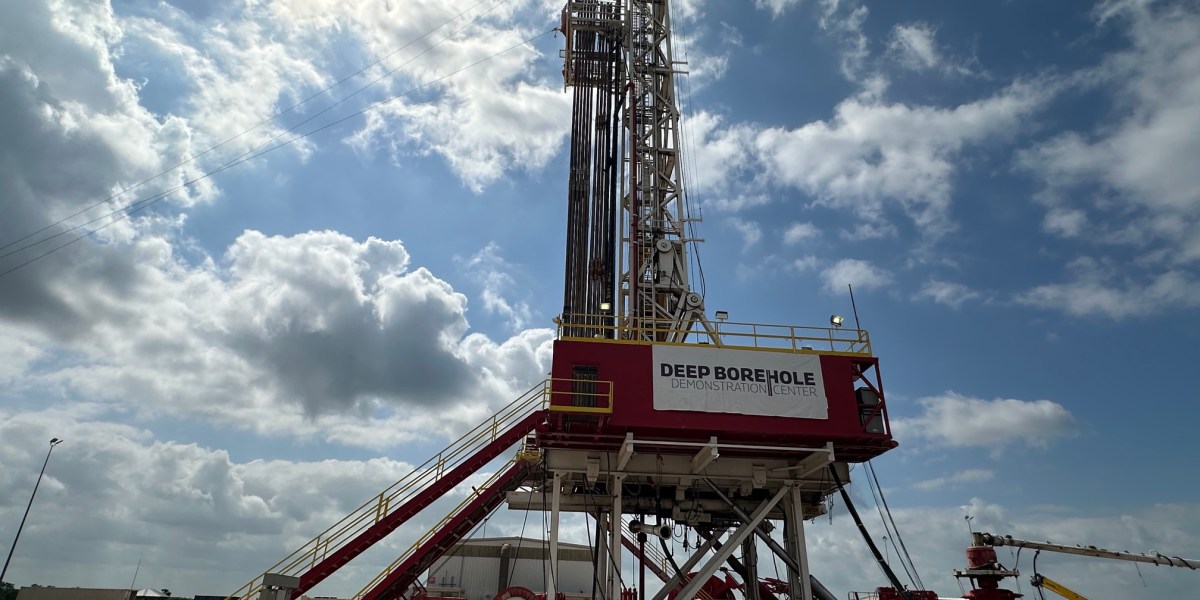
A drive into the remote Texas countryside near Cameron—a town of 5,300—leads down a gravel road to a security gate bearing a sign: "Watch out for the cows." The warning is literal; cattle block the path, delaying the arrival at a massive oil-drilling rig. A bearded man in red Halliburton coveralls and helmet cautions visitors about snakes and scorpions. "Not trying to scare you; that's just part of the orientation," he says.
Welcome to the Deep Borehole Demonstration Center, the proving ground for a bold solution to America's nuclear waste dilemma. The site is a joint effort between Deep Isolation, a nuclear waste startup, and Halliburton, the oilfield services leader known for its drilling and fracking expertise, along with other partners. Their goal: use modern directional drilling to bury radioactive waste in custom-designed 5,000-pound canisters about two miles underground, permanently isolating it from the environment.
"To make sure we have a good path for new nuclear, we need to make sure we take care of the waste," says Deep Isolation CEO Rod Baltzer. "We can go twice as deep as a typical mined repository, and then follow a formation that's been out of touch with the surface for a million years."
The urgency is clear. More than 95,000 metric tons of spent nuclear fuel are stored in temporary facilities across 80 sites in over 30 states, with no permanent home. The decades-long effort to build a national repository at Yucca Mountain in Nevada has stalled, and the federal government is still searching for a path forward. In July, the U.S. Department of Energy named five states—Idaho, Louisiana, Oklahoma, Tennessee, and Utah—as finalists for "Nuclear Lifecycle Innovation Campuses" to explore recycling and waste management. Even if recycling succeeds, leftover waste will remain.
Deep Isolation's approach is to drill boreholes near nuclear plants, eliminating the need for long-distance transport. "You can put it where the waste is generated," Baltzer notes. The idea of combining oil and nuclear waste techniques was considered decades ago, but technology and economics weren't ready. Now, the oil industry has perfected drilling long, horizontal wells to unlock crude from deep rock formations. For Deep Isolation, the canisters can even be retrieved in an emergency.
Baltzer recalls that the nuclear industry was largely unaware of the leaps in oil drilling over the past 10 to 20 years. "Everybody in oil and gas was like, 'We do this every day,'" he says. "And everybody in nuclear went, 'Holy cow, I did not know you could do this and retrieve it.' There was this disconnect—they just weren't talking to each other."
Time is pressing, says Jesse Sloane, Deep Isolation's executive vice president of engineering. The Trump administration has committed to quadrupling nuclear power by 2050. "You can't do that without answering the question of, 'Well, what do you do with the waste?'" Sloane says.
Early next year, Halliburton will drill the first test well using an extra-large drill bit, going thousands of feet underground vertically and then horizontally. The team will demonstrate that a crane can retrieve each canister individually. "The nuclear community really wants to see us physically do something at scale and at depth here before they can really get behind it," says Andy Griffith, executive director of the demonstration center and a former deputy assistant secretary of nuclear energy at the DOE. "Even today, people are saying, 'Well, I don't know, it's so risky. What if it gets stuck? What if the seal doesn't work?' And the oil and gas industry people are like, 'This is not a big deal.'"
The shale oil boom was revolutionized by drilling vertically and then horizontally to crack open rock. The same technique applies here, but instead of extracting oil, it carries nuclear waste canisters away from the surface. A common misconception is that the well forms an "L" shape. In reality, the bend is gradual—about 4 degrees per 100 feet. "It's a very gradual bend," Griffith says. "If you're looking down a 4-degree-per-100-foot bend, you can't tell it's bent."
While oil wells routinely reach 4 miles horizontally, replicating this for nuclear waste is no simple task. A typical oil well is about 8 inches wide near the bottom; the nuclear waste well requires a 22-inch diameter—nearly triple the size. This means using a larger drill bit and then a "hole opener" to expand the width. Jason Foreman, Halliburton's North America region manager, calls it a unique challenge. "We drill wells all around the world in various combinations of challenges, and we do it every day," he says. "This project pulls them all together. It's a combination of depth, deviation, horizontal reach, hole diameter, and abrasive formation that we're not sure has been done before."
The cost of drilling these 15-foot canister wells is high, but Deep Isolation bets it will be far cheaper than building massive repositories like Yucca Mountain. Halliburton sees it as a natural extension of its core business. "Nuclear is another source of energy," Foreman says. "From our perspective, it's a well."
Deep Isolation was founded a decade ago by Liz Muller and her physicist father, Richard. They recruited Baltzer in 2018, and Liz Muller handed the CEO reins to him in 2024 to start a sister company, Deep Fission, which develops underground small modular reactors. Deep Isolation went public on the OTCQB market in July with a market cap of nearly $300 million. Still, Baltzer acknowledges the need to prove the demonstration project, attract more capital, and navigate regulation.
"After spending 25 years in the back end of the nuclear fuel cycle with waste, this is the most interest I've ever seen," Baltzer says. Last month, the DOE awarded Deep Isolation three grants with Lawrence Berkeley National Laboratory and the University of South Carolina as part of the Trump administration's "Genesis Mission" to use AI for energy dominance, focusing on AI modeling for waste site screening and design.
The biggest hurdle may be the federal Nuclear Waste Policy Act, which effectively bars permanent waste disposal licensing outside Yucca Mountain—a project now essentially defunct. The Trump administration and Congress are weighing solutions. While sentiment is shifting toward nuclear power, many communities remain skeptical of both plants and waste storage. That's why Nevada was long seen as the easiest option.
Safety must be proven definitively. In the meantime, Baltzer knows the first commercial project may have to be international. Deep Isolation is in talks with Bulgaria and other partners. The initial project is unlikely to come online until the early 2030s, but that timeline could align with a nuclear renaissance if regulatory reforms are in place.
"We want to bring our communities out, our regulators out, and let them kick the tires, and see how it works," Baltzer says. So, grab a helmet and head to central Texas. Just beware of the snakes.
Article commentary
This partnership between a nuclear startup and an oilfield giant represents a pragmatic fusion of industries, leveraging established drilling expertise to tackle a long-standing waste problem. The approach is promising on paper, but regulatory inertia and public skepticism remain formidable obstacles. The shift from a centralized repository like Yucca Mountain to localized, deep boreholes could reshape nuclear waste policy, but proof of concept at scale is critical. The involvement of Halliburton adds credibility, though the demonstration must address technical concerns. If successful, this could accelerate the nuclear renaissance needed for AI-driven energy demands. However, the timeline stretching into the 2030s suggests patience is required.