Freeman Avoids Major Injury in Frightening Dugout Fall
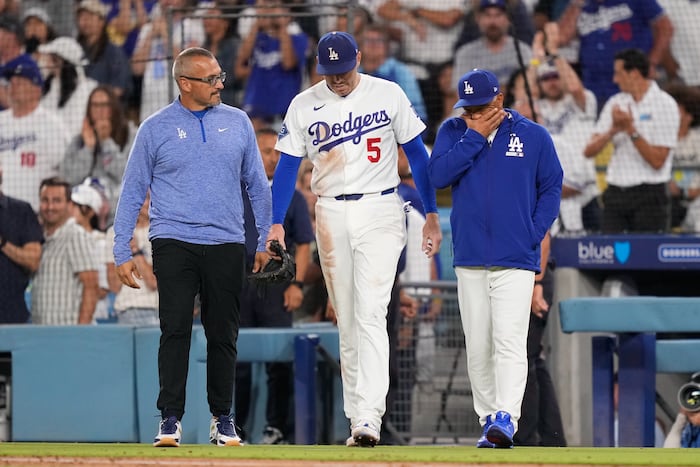
Source: WPLG Local 10 News Sports. Casualplayhub News adds summary, context, and editorial framing while linking back to the original report.
LOS ANGELES — Freddie Freeman’s pursuit of a foul popup turned into a heart-stopping moment Wednesday night, but the Dodgers’ first baseman emerged with no apparent broken bones, only a collection of bruises and a story to tell.
In the top of the eighth inning, Freeman tracked Isaac Collins’ pop fly drifting toward the visitors’ dugout. As he leaned back, expecting to brace against the railing, he found nothing but air. “I went to lean, like I was going to lean against the rail to catch the ball — and obviously there was no rail,” Freeman said, a wry smile crossing his face. He tumbled down the stairs, landing hard on the dugout floor.
Teammates and Kansas City Royals rushed to his side, urging him to stay down. But Freeman stood up, and the Dodgers’ training staff sprinted across the field to check on him. The 2024 World Series MVP reported that he avoided the worst: “I didn’t hit my head, so that was the key part there.” He described his condition as sore, with his kneecaps, shoulder, hand, and wrist all taking the brunt of the fall. The right side of his body absorbed the punishment, yet X-rays ruled out fractures.
Freeman stayed in the game to finish the top of the eighth but was lifted for a pinch hitter, Tommy Edman, in the bottom half. Los Angeles held on for a 4-2 victory over the Royals, their fourth win in five games. The immediate concern now shifts to Thursday, when the back-to-back World Series champion Dodgers open a pivotal four-game series against the Milwaukee Brewers, the team with MLB’s best record. The series is a rematch of last year’s National League Championship Series.
Freeman’s escape from serious injury hinged on his height. At 6-foot-4, he said he fell past the top flight of stairs entirely, landing such that his head extended into the open space above the second flight that leads to the visitors’ clubhouse. “Luckily, I was tall, so I missed everything else,” he joked.
This was not the first time Freeman has had a fielding misadventure. He recalled falling into the seats in Arizona roughly a decade ago during his tenure with the Atlanta Braves. He also vividly remembered watching Mo Vaughn’s infamous dugout fall on opening day in 1999, when Vaughn got hurt on the first play of his first game with the Angels. Growing up as an Orange County native and Angels fan, that image stuck with him.
Dodgers manager Dave Roberts expressed relief, saying, “I think that we really dodged a bullet. Very scary visually. For right now, he’s in good spirits, which I think is a good sign. Just kind of total body soreness.”
Freeman will decide whether to play Thursday based on how he feels in the morning. The Dodgers are counting on his bat and leadership as they navigate a tight division race. For now, the team can breathe easy, knowing their star first baseman walked away from a fall that could have been much worse.
Article commentary
Freddie Freeman’s tumble into the visitors’ dugout Wednesday night was a scene that willed the collective breath of Dodger fans to a halt. The fact that he walked away with only soreness, no concussion, and no fractures is a stroke of fortune that speaks to both his physical resilience and a bit of geometry. At 6-foot-4, his height turned a potential disaster into a bruising lesson in spatial awareness. But beyond the immediate relief, this incident opens a window into the broader calculus of player safety and team dynamics. First, the Dodgers’ schedule. They face the Milwaukee Brewers in a four-game series that carries significant weight. Milwaukee holds the best record in MLB, and the Dodgers are chasing them in the standings. Losing Freeman for any extended period would be a serious blow. He is the engine of the lineup, the 2024 World Series MVP, and a player whose presence in the batter’s box often dictates how pitchers approach the entire order. Even a day off could disrupt the rhythm of a team that has been surging with four wins in five games. Freeman’s decision to stay in the game briefly before being pinch-hit for reflects a common tension in professional sports: the competitor’s instinct to play through pain versus the medical staff’s caution. He was sore enough to be removed, yet he finished the half-inning. That’s a testament to his toughness, but it also raises questions about whether the team should have pulled him immediately. The Dodgers’ training staff acted quickly, and the fact that Freeman was able to joke about the fall afterward is a positive sign. However, the phenomenon of post-injury adrenaline masking more serious damage is well-documented. The team will need to monitor him closely over the next 48 hours. This incident also fits into a larger pattern of dugout and railing accidents in baseball. Mo Vaughn’s fall in 1999 remains a cautionary tale, and Freeman’s own recollection of a similar mishap a decade ago shows that even veteran players can misjudge boundaries. The configuration of dugout steps and railings varies across ballparks, and while safety standards have improved, the human element of tracking a ball in the air introduces an element of unpredictability. The league may want to review whether uniform padding or rail height guidelines could mitigate such risks, especially for players who are taller or who pursue foul balls aggressively. From a narrative standpoint, Freeman’s humor and self-deprecation about the incident are classic. He called himself lucky to be tall, and he smiled when recounting the missing railing. That lightheartedness, while genuine, should not obscure the fact that this was a serious fall. The Dodgers’ phrase “dodged a bullet” is apt, but it also serves as a reminder of how fragile a season can be. One misstep, one missing railing, and a championship run can be altered. Looking ahead, the Dodgers’ depth will be tested if Freeman misses time. Max Muncy or Kiké Hernández could fill in at first base, but neither brings Freeman’s combination of left-handed power, on-base consistency, and defensive reliability. The Brewers series will be a litmus test for how the team handles adversity, and whether they can maintain momentum without their star. For now, the organization—and its fans—can exhale, knowing that the scare did not become a catastrophe. But the incident should prompt a conversation about dugout safety and the fine line between instinct and injury that players walk every night.