Car Bombs Become Cartels’ Latest Tool of Terror in Mexico
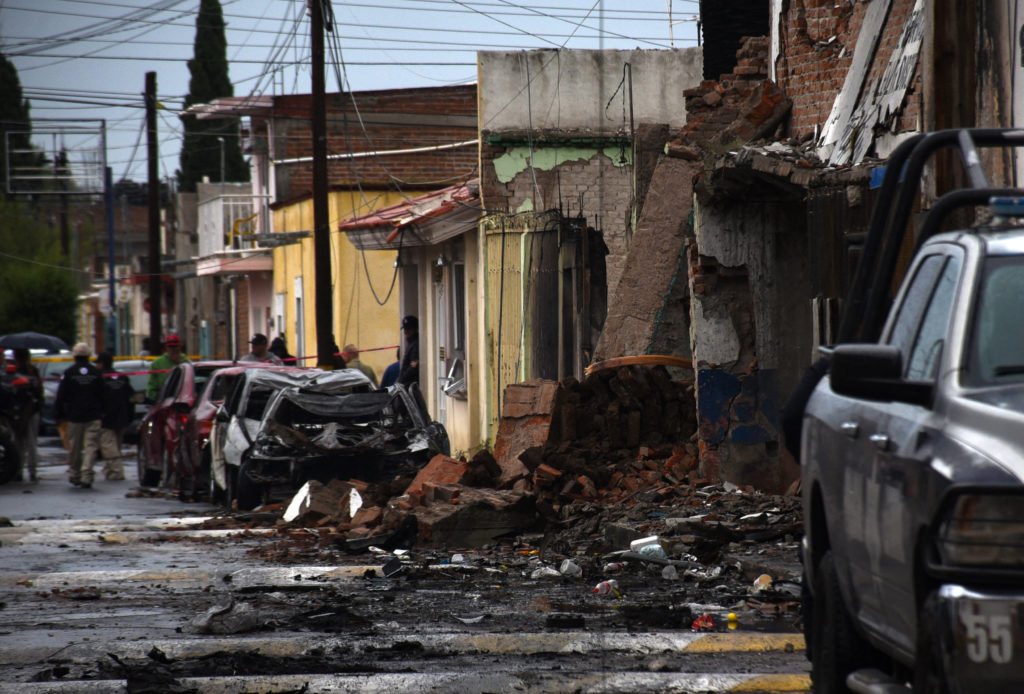
Source: PBS NewsHour World. Casualplayhub News adds summary, context, and editorial framing while linking back to the original report.
Ad eligibility review: sensitive-topic
MEXICO CITY — Drug cartels in Mexico are rewriting their playbook, turning to car bombs, explosives-laden drones, and improvised explosive devices in a dangerous escalation that could further strain the country’s already fraught relationship with the United States. President Donald Trump has repeatedly threatened unilateral military action against the cartels, and this new trend may provide fresh ammunition for those calls.
The most recent incident unfolded last Sunday night in the quiet town of Ojocaliente, nestled in the north-central state of Zacatecas, roughly 360 miles northwest of Mexico City. A massive bomb — 200 kilograms of explosives — detonated outside a local police station. While no one was killed, the blast injured 11 people and damaged more than 60 homes in the city center. Mexico’s security chief, Omar García Harfuch, confirmed the details during a Friday visit to Zacatecas alongside President Claudia Sheinbaum.
Zacatecas has become a flashpoint. According to state Attorney General Cristian Paul Camacho, the region has recorded 23 attacks involving explosives so far this year, six of them involving vehicles packed with explosives. The violence is driven by a brutal turf war between two of Mexico’s most powerful criminal organizations: the Jalisco New Generation Cartel, or CJNG, and the Sinaloa Cartel, which have fought for years over control of the state’s lucrative trafficking routes.
Car bombs are not new to Mexico, but they have historically been rare. Victor Manuel Sánchez, a professor at the University of Coahuila who has tracked such attacks for decades, notes that an early example occurred in 1994 in Guadalajara, when the Tijuana Cartel targeted Sinaloa Cartel co-founder Ismael “El Mayo” Zambada. More recently, the CJNG has become the primary user of explosives as it expands its reach. Authorities attribute two recent bombings to the group: one in Michoacán in December that killed five people, and the Ojocaliente attack.
The CJNG is among eight Mexican cartels designated as foreign terrorist organizations by the Trump administration — a label that carries significant legal and military weight. The use of explosives by cartels is a relatively recent phenomenon. About five years ago, they began dropping bombs from drones to attack security forces or rival groups, and burying IEDs to defend or control territory. In 2023, roadway bombs in the western state of Jalisco killed six people and injured 14 others. A month later, the military acknowledged the growing threat, reporting it had seized approximately 2,800 explosive devices nationwide over the previous four and a half years. The following year, authorities in Michoacán alone deactivated nearly 3,200 devices. In 2025, an explosive device in that same state killed eight soldiers in one of the deadliest incidents of its kind. Nationwide figures for 2026 have not been released.
“It is all a bad development in Mexico,” said Vanda Felbab-Brown, an organized crime expert at the Brookings Institution. “We are facing steady intensification of violence. This certainly greatly intensifies the atmosphere of fear and retaliation.” President Sheinbaum, however, struck a different tone during her visit to Zacatecas, insisting that a nationwide decline in killings is clear evidence that her government’s strategy is working.
Experts say cartels use car bombs strategically — to intimidate rivals, pressure authorities, and spread fear among the civilian population. Carlos Pérez Ricart, an international studies professor at Mexico’s CIDE university, explains that such attacks draw significant attention and can be used to force the government into negotiations, especially when criminal groups feel cornered.
Mexico has long resisted calling cartel violence terrorism, partly out of fear that such a designation could invite foreign intervention and harm tourism and investment. Felbab-Brown points out that another argument is that terrorism typically involves political or ideological aims, while cartels are driven by profit. Yet civilians have been deliberately targeted in the past. In 2008, grenades thrown into a crowd celebrating Independence Day in Morelia, Michoacán, killed eight and wounded dozens. Three years later, gunmen set fire to a casino in northern Mexico, killing 52.
The Trump administration’s designation of eight cartels as foreign terrorist organizations — and its openness to using that framework to justify military action — has made the terminology more consequential. Pérez Ricart warns against applying counterterrorism strategies to organized crime. “The answer to terrorism is the disappearance of the enemy,” he says, while in the drug trade the adversary is not simply an armed group but an entire illegal market.
As the use of explosives spreads, the challenge for Mexico — and its relationship with the United States — only grows.
Article commentary
The rising use of car bombs and other explosives by Mexican cartels marks a troubling evolution in the country’s long-running conflict. While such attacks remain numerically small compared to the violence that plagued Colombia during its drug wars, their symbolic and psychological impact is immense. A car bomb in a quiet town center sends a message not just to rival cartels but to the state itself: we can strike anywhere, anytime. This escalation comes at a particularly sensitive moment. The Trump administration’s designation of eight Mexican cartels as foreign terrorist organizations — and its repeated threats of military intervention — have raised the stakes. Any significant cross-border incident involving explosives could become a casus belli. The cartels, aware of this, may be testing the limits of U.S. patience. Alternatively, they may be using bombs to pressure the Mexican government into negotiations, as Carlos Pérez Ricart suggests, or to demonstrate strength in the face of a crackdown. President Sheinbaum’s insistence that a nationwide decline in homicides proves her strategy is working feels increasingly disconnected from the reality on the ground in states like Zacatecas and Michoacán. While overall murder numbers may be down, the nature of the violence is becoming more indiscriminate and more destructive. The use of explosives — particularly in civilian areas — blurs the line between organized crime and terrorism, even if Mexico’s government continues to resist that label. The academic debate over whether to call cartel violence terrorism is not merely semantic. As Vanda Felbab-Brown notes, the terrorism designation could invite foreign intervention and harm tourism and investment. But it also shapes how the United States responds. Counterterrorism frameworks typically prioritize the elimination of the enemy, whereas counter-narcotics strategies focus on disrupting markets and supply chains. Applying the wrong model could be counterproductive. The cartels’ shift to explosives also reflects a broader technological adaptation. Drones, IEDs, and vehicle bombs are relatively cheap, easy to conceal, and highly effective at generating fear. The Mexican military’s seizure of thousands of devices over the past few years suggests the problem is not isolated. Yet the government has struggled to provide a comprehensive response, often reacting after the fact rather than preventing attacks. Historical patterns are instructive. Car bombs were once a signature of the Tijuana Cartel’s audacity, but they remained rare for decades. Now the CJNG is resurrecting the tactic with greater frequency and sophistication. The use of drones and IEDs shows a willingness to adapt military-style tactics. This could lead to a cycle of escalation: as the government improves its defenses, cartels will seek more destructive methods. The risk of a catastrophic attack — one that kills dozens or even hundreds — is real. The international community, particularly the United States, must help Mexico strengthen its forensic and intelligence capabilities to track bomb-making materials and disrupt networks. Without that, the sound of car bombs may become a regular feature of Mexican life.