Nvidia CEO Declares AGI Arrival, But Markets Remain Unimpressed
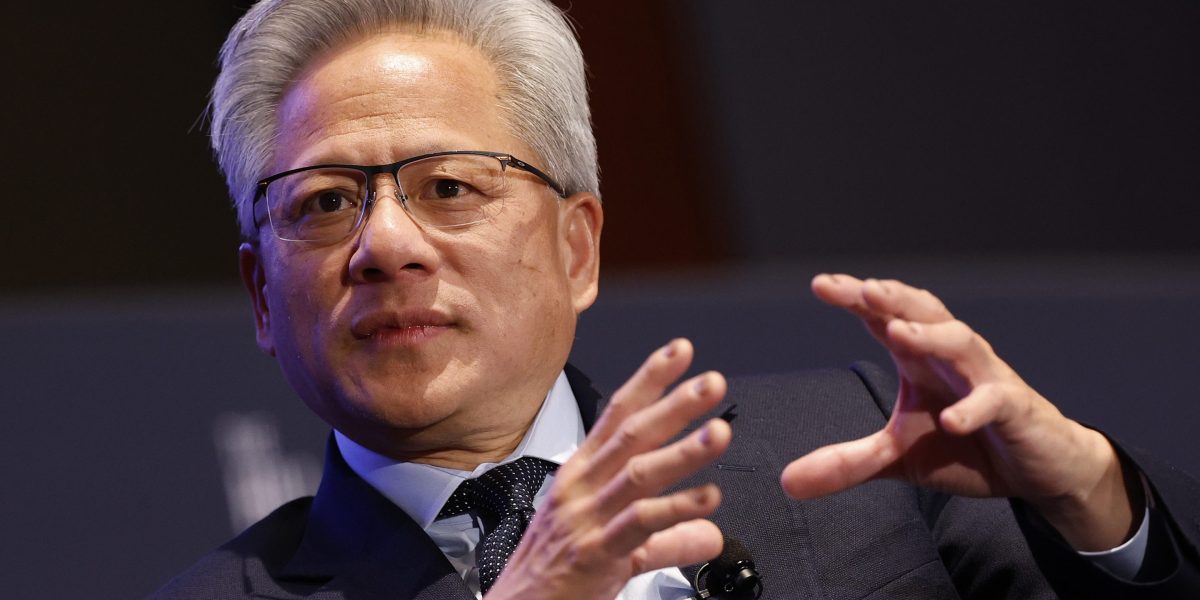
Source: Fortune. Casualplayhub News adds summary, context, and editorial framing while linking back to the original report.
Ad eligibility review: sensitive-topic
Over the long Labor Day weekend, Jensen Huang, chief executive of Nvidia, took to X to declare that artificial general intelligence has finally arrived. The technology, long imagined as a force capable of reshaping civilization for better or worse, is now a reality, he said, pointing to OpenAI's latest creation: Astra, a model named after the Latin word for stars. According to Huang, Astra achieved AGI after training on 100,000 Grace Blackwell chips—though an earlier post mentioning 300,000 was quickly deleted. The announcement drew a predictable split. Jim Cramer cheered Nvidia's win. Hunter Horsely, a crypto CEO, called Huang the most credible referee. But Gary Marcus, a prominent AI critic, asked pointedly whether Huang had a financial motive to declare AGI.
Markets had their first chance to respond on Tuesday after the holiday. CoreWeave, a cloud provider long under scrutiny for its debt levels, shot up 15%. SoftBank added another 2%. But Nvidia itself, the heavyweight of the sector, slipped 2%. This pattern is familiar: the last time Huang declared AGI—on Lex Fridman's podcast in March—the stock fell 0.3%. The reaction suggests either that investors do not buy Huang's claim, or that AGI has already been priced into Nvidia's stratospheric valuation. Gil Luria, head of technology research at D.A. Davidson, sees a more nuanced picture. He told Fortune that the market is responding, just not in the way one might expect. The companies most leveraged to OpenAI—SoftBank, Oracle, CoreWeave—are the ones rising. For Luria, Astra restores OpenAI's status as the state-of-the-art model, a position it had lost for about a year. Nvidia, meanwhile, has dominated since 2024 and is now too big to grow meaningfully. Two weeks ago, it reported the most profitable quarter in capitalism's history: $96 billion in quarterly revenue, up 106% year over year, with a guidance of $108 billion for the current quarter. Luria summed it up: They are so good that nobody believes it can continue. For traders, Nvidia stock has become more of a funding source—sold to buy into names like CoreWeave—than an asset traded on individual news. That also explains why Luria brushed off a filing by board member Mark Stevens to sell up to $1 billion of his shares. Good for him, Luria said.
But what about AGI itself? In March, Huang defined the term on Fridman's podcast as the ability to create a $1 billion company. He did not repeat that benchmark in his latest post. Can Astra build such a company? Theoretically, Luria said, but until a single person using an AI model creates a billion-dollar business—or an agent does it entirely alone—it remains a hypothetical. AI researchers apply a sterner test. A widely cited definition describes AGI as an AI that can match or exceed the cognitive versatility and proficiency of a well-educated adult. Gary Marcus and Miles Brundage, a researcher who left OpenAI in 2024 over safety concerns, compiled a 10-point list to make that concrete: a well-educated adult can write an Oscar-caliber screenplay, laugh at the right moments in a movie, and master a new video game within hours. By that standard, we are absolutely not there, said Basil Halperin, an economist at the University of Virginia who co-authored a 2023 analysis arguing that financial markets do not anticipate transformative AI for decades. Halperin ran his own test over the weekend, asking GPT-5.6 to migrate his old iTunes playlists to Spotify. It got the job done, he said, but I had to sit there babysitting it for three hours.
One might think a spectacular model release would drive up demand for compute, lifting Nvidia's stock or at least the shares of hyperscalers selling compute. Not necessarily, Halperin argues. Stocks are a giant pain because they reflect many different things. The two leading labs remain private. Concerns about existential or cybersecurity risk could push equities down as investors flee to Treasuries and gold. And competition between OpenAI and Anthropic might leave the industry resembling Uber and Lyft—profitable, but not as lucrative as Google or Apple. Where AGI would really show up, Halperin contends, is in real interest rates. If AI boosts growth, it lifts rates, because rates are the expected discounted value of future earnings. A stock's price is the discounted value of its future earnings, so higher rates reduce the present value of future profits. Paradoxically, a genuine AGI could make Nvidia's stock fall. The real interest rate—the yield on inflation-protected Treasuries (TIPS)—offers a cleaner signal. Halperin's rule of thumb: each percentage point of extra growth adds roughly a percentage point to real rates. When Sam Altman and Dario Amodei talk about growth of 5% or 10% or more, they describe a world where real rates sit near 10%. That would swamp everything. But that is not happening. Real rates have climbed three to four percentage points since 2021, partly due to hyperscalers' capex, now around 2% of GDP. Yet that is nowhere near a singularity, and Astra added little. In fact, a paper by MIT economists Isaiah Andrews and Maryam Farboodi found that long-term Treasury yields have on average fallen by more than a tenth of a percentage point around major model releases and stayed down for weeks, a pattern suggesting the market has been disappointed. The efficient market aggregates the views of the general public, not X. A survey Halperin helped run showed that most people—from normal individuals to AI researchers—expect AI to add about half a percentage point to GDP growth. That is enormous on one hand, and nothing on the other. Halperin's own forecast for the next five years is like the dot-com boom, but twice as fast and twice as hard. Not the singularity. Not yet. And that, he says, is what the markets are signaling.
Article commentary
When a CEO of the world's most valuable chip company declares that AGI has arrived, it should rattle markets, reshape investment strategies, and ignite a new wave of public debate. Yet the tepid response to Jensen Huang's announcement reveals something deeper: Wall Street has become remarkably sophisticated in parsing AI hype from substance. The 2% dip in Nvidia's stock, contrasted with surges in CoreWeave and SoftBank, tells a story of sector rotation rather than a paradigm shift. Investors are betting on the beneficiaries of OpenAI's resurgence—CoreWeave as a direct compute provider, SoftBank as a major backer—while treating Nvidia as a mature giant whose future growth is already priced into its colossal valuation. This marks a departure from the early euphoria of 2023, when any AI-related announcement could send Nvidia shares soaring. The core issue lies in the definition of AGI itself. Huang's own benchmark—the ability to create a $1 billion company—is both clever and vague. It sidesteps the rigorous cognitive tests that AI researchers demand. By his standard, AGI becomes a financial milestone rather than a scientific one, conveniently aligning with Nvidia's business model of selling the hardware that powers AI. Critics like Gary Marcus are right to flag the conflict of interest: Huang's declaration serves to sustain the narrative that drives demand for Nvidia's chips. The market seems to sense this. Real interest rates, which Halperin rightly identifies as a purer indicator of transformative economic impact, barely moved after Astra's release. The pattern of yields falling after major model releases suggests that investors, when they vote with their bond portfolios, remain unconvinced. There is also a structural mismatch between AI's potential and its current economic footprint. The hyperscalers' capital expenditure is running at about 2% of GDP, a significant sum that has contributed to the rise in real rates since 2021. But that investment has not yet translated into productivity gains large enough to lift growth expectations dramatically. The survey showing that most people expect AI to add only half a percentage point to GDP growth over the next five years reflects a sober assessment. Even a dot-com-boom-times-two scenario, as Halperin describes, is a far cry from the singularity that Altman and Amodei sometimes invoke. The market is effectively saying: show us the billion-dollar company built by one person with an AI model, or a sustained uptick in real rates, before we adjust our portfolios. This skepticism is healthy. It prevents capital from being misallocated based on hype alone. But it also creates a tension: if AGI truly arrives, the market's current indifference could prove shortsighted. The real interest rate argument, while elegant, depends on the assumption that AI's impact will be diffuse and gradual. If Astra or its successor enables a sudden leap in productivity across multiple industries, rates could spike quickly, catching investors off guard. The gap between what Huang declares and what the market believes may narrow faster than expected. For now, though, the evidence tilts toward caution. The market is not ignoring Huang; it is weighing his incentives against the empirical data, and finding the scales tipped toward skepticism. That discipline, rather than blind faith, is what makes financial markets a useful corrective to Silicon Valley's boundless optimism.