Power Outage Tests Faulk's Southern Team Ahead of Houston Clash
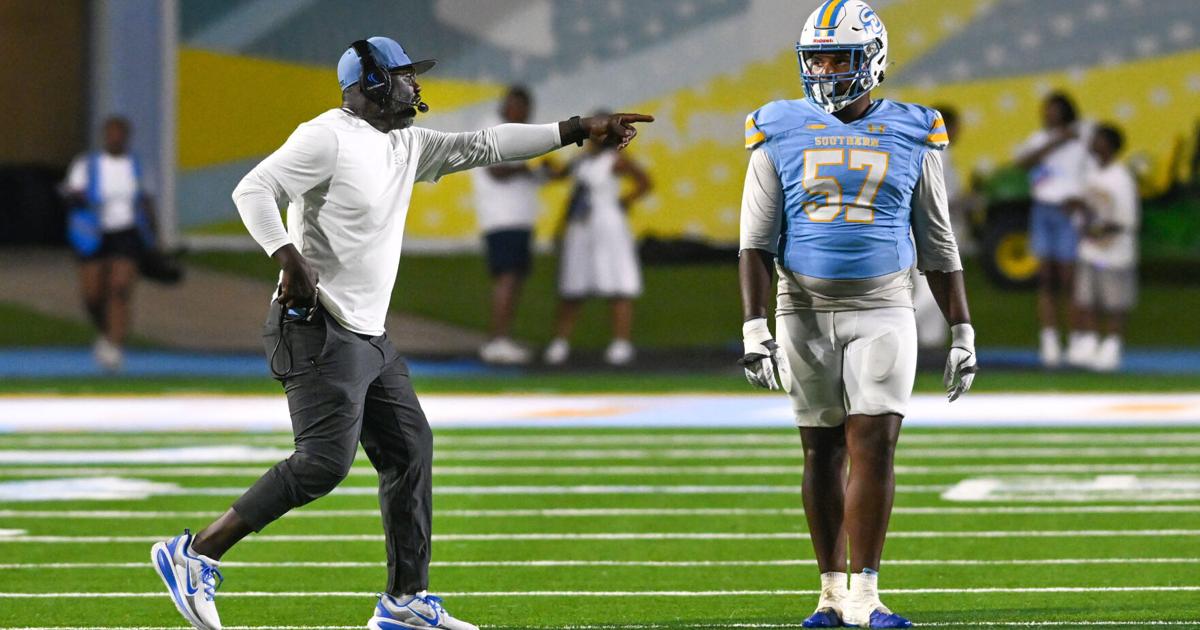
Source: Nola Sports. Casualplayhub News adds summary, context, and editorial framing while linking back to the original report.
Ad eligibility review: sensitive-topic
Marshall Faulk is learning the hard way that coaching college football is about more than just play-calling. In his first season at Southern University, the Pro Football Hall of Fame running back has already navigated a weather delay during the home opener. Now he is dealing with a campus-wide power outage that has scrambled the Jaguars' practice routine and forced creative solutions ahead of a Saturday matchup against No. 22 Houston.
The electrical failure began Monday, knocking out power in four residential halls. The university canceled classes Tuesday and shifted to remote learning Wednesday while crews worked to repair failed equipment that affected voltage distribution across campus. A statement from the school Tuesday did not provide a timeline for restoration, and the university also experienced a separate campus-wide outage on Sept. 2.
For the football team, the disruption has been immediate and tangible. Practices have moved off campus entirely. Players and coaches now board buses each morning to travel to the Elite Training Academy in Baton Rouge. The team has also been using a meeting room at a local Marriott to watch film and study Houston's schemes, though Faulk described the ability to review tape on campus as "spotty."
"You can use it as a negative and let it do that, or use it as a positive," Faulk said during a virtual media availability on Wednesday. "What I just keep telling them is this builds character, the resiliency that we got to show."
When asked directly whether the power issues have hindered preparation for Saturday's 6 p.m. game at TDECU Stadium, Faulk did not sugarcoat his answer. "Hell yeah," he said.
The logistics alone are draining. "Not only do they have to get up early, go to breakfast, go to treatment and do all of that stuff," Faulk explained, "well now you throw in the fact that we got to get on buses, we got to go down to a different facility and train. So when it's game time Saturday, when I get ready to talk to the team, and I tell them that (Houston) haven't done what we've done to play this game, I mean it."
Faulk, known for his elusiveness during an NFL career that landed him in Canton, is trying to turn the inconvenience into a rallying point. The Marriott donated meeting space for the team to prepare. "We midstream, we adjust, that's what this game is about," he said. "Albeit it's not the ideal situation, we still got to show up, man. Houston, they don't care. We don't get to phone in, 'Houston, we have problems.' We're not NASA."
The coach acknowledged that the mental toll is real. "To say that it doesn't get in their head would be lying," Faulk said. He has urged players to focus on the goal—winning football games—rather than wishing for different circumstances. "We don't wake up in the morning and wish for things to be different," he said. "We wake up in the morning and just wish that we could be better. And that's what they're doing."
Despite the chaos, Faulk reported that Wednesday's practice was "very high level" with the effort needed for growth. "With this being day two of us busing, going to a facility, needing to work out, it's like it shouldn't be that way," he said. "But it is, and like I said, nobody cares. You guys want to see a game. We got to go out there, and we got to compete."
Southern enters the game with a 1-1 record, while Houston is 1-0. The Jaguars will face a ranked opponent on the road, a daunting task even without the distractions of the past week. But Faulk is betting that the hardship will forge a sharper team. Whether that translates into an upset remains to be seen, but his players are getting a crash course in resilience.
Article commentary
The power outage at Southern University has thrust Marshall Faulk into a masterclass in adversity management just two games into his head coaching career. While the immediate concern is whether the Jaguars can compete with a ranked Houston team on Saturday, the broader story is about leadership under duress and the often-unseen operational challenges that can define a program. Faulk's handling of the situation reveals several key dynamics. First, he is not treating the outage as an excuse. His blunt answer—"Hell yeah"—when asked if it affected preparation shows honesty without self-pity. He acknowledges the difficulty but immediately reframes it as a character-building opportunity. This is a classic coaching tactic: use external obstacles to unify a team and sharpen its focus. The reference to NASA is particularly telling—he refuses to let his team play the victim card, knowing Houston will bring its best regardless. Second, the logistical improvisation—busing players to an off-campus facility, using a Marriott meeting room for film study—highlights the resourcefulness required at programs outside the Power Five. Southern does not have the deep infrastructure of a Houston or an Alabama. When the lights go out, there is no alternative stadium or backup generator waiting. The reliance on a hotel's generosity underscores the disparity in resources between Group of Five programs and their larger counterparts. It is a reminder that inequality in college athletics runs far deeper than recruiting rankings or television contracts. From a psychological perspective, Faulk's admission that the situation affects players mentally is refreshingly candid. Many coaches would downplay the impact to avoid giving opponents bulletin-board material. But by acknowledging the reality, Faulk can address it head-on. His message that Houston doesn't care about Southern's problems is a powerful motivator: football is a meritocracy where results matter, not excuses. There is also a subtler angle here: the contrast between Faulk's NFL experience and college coaching. In the pros, teams have extensive support staff, facility redundancy, and financial buffers. At Southern, the head coach is managing a crisis that involves residential housing, university administration, and bus schedules. This game will be a test not just of the Jaguars' talent, but of Faulk's ability to insulate his players from chaos while preparing them to perform. Regardless of Saturday's outcome, the manner in which Faulk has responded to this early-season turbulence will likely shape how his players view adversity for the rest of the year. If Southern pulls off an upset, the narrative will be about resilience. If they lose, the lesson will still hold: that preparation is not about perfect conditions, but about adapting when conditions are far from perfect. The most important takeaway, however, may be for fans and administrators. Power outages are rare, but the fragility of campus infrastructure is a real concern. That a football team had to rely on a hotel for meeting space speaks to broader systemic issues. For now, Faulk is making the best of a bad situation—and in doing so, providing a case study in leadership that goes far beyond the scoreboard.