Trump Declares Strait of Hormuz US Territory, Iran Vows to 'Correct His Delusion'
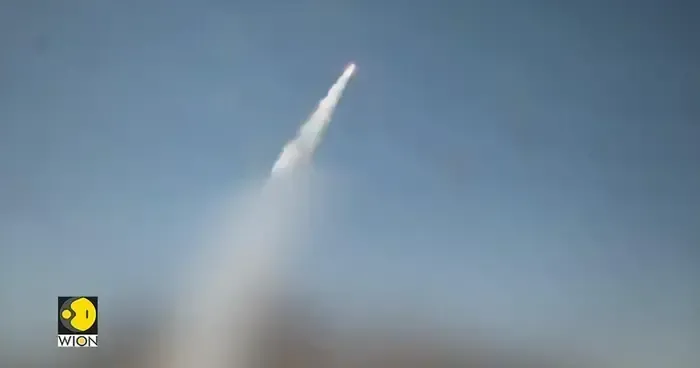
Source: Press of Alantic City Business. Casualplayhub News adds summary, context, and editorial framing while linking back to the original report.
The Strait of Hormuz, a narrow chokepoint connecting the Persian Gulf to the Gulf of Oman, has suddenly become the center of a new geopolitical storm. Former President Donald Trump, in a move that has stunned diplomats and analysts alike, declared the waterway a 'new US territory' during a recent public appearance. The declaration, which carries no legal weight under international law, has nonetheless ignited a firestorm of fury in Tehran.
Iran's government wasted no time in issuing a blistering response. A senior Iranian military commander, speaking on condition of anonymity, stated that the country would 'correct Trump's delusion by any means necessary.' The language was unmistakably bellicose, hinting at potential military action to challenge what Iran sees as an illegal claim. State media amplified the rhetoric, with commentators accusing Trump of 'warmongering' and 'imperialist arrogance.'
The Strait of Hormuz is not just any piece of water. It is the world's most critical oil transit passage, handling roughly 20 million barrels of crude per day. Any disruption there sends shockwaves through global energy markets, driving up prices and threatening economic stability. Iran has historically used its strategic position along the strait as leverage, threatening to block it during past standoffs with the United States.
Trump's declaration has no precedent in modern international relations. No sitting or former U.S. president has ever unilaterally claimed a major international waterway as sovereign territory. Legal experts were quick to dismiss the claim as 'legally frivolous,' pointing out that the strait is governed by the United Nations Convention on the Law of the Sea, which guarantees freedom of navigation. But the political impact is far from frivolous.
In Tehran, the reaction was swift and organized. The Supreme National Security Council convened an emergency session, and the foreign ministry summoned the Swiss ambassador, who represents U.S. interests in Iran. The message was clear: Iran would not tolerate what it views as a threat to its territorial integrity and national security.
Trump, for his part, showed no signs of backing down. In a brief statement to reporters, he dismissed the idea of talks with Iran, saying, 'There will be no negotiations. They understand only strength.' This hardline stance echoes his previous approach toward Iran during his presidency, which included the withdrawal from the nuclear deal and the assassination of General Qassem Soleimani.
The immediate question is whether this war of words will escalate into direct military confrontation. The U.S. Navy's Fifth Fleet, based in Bahrain, maintains a significant presence in the region. Iran's Revolutionary Guard Corps has a fleet of fast-attack boats and anti-ship missiles positioned along the coast. Any miscalculation could trigger a skirmish that spirals into a wider conflict.
Regional powers are nervously watching. Saudi Arabia and the United Arab Emirates, both heavily dependent on oil exports through the strait, have called for restraint. Iraq, which relies on the waterway for its own oil exports, has offered to mediate. But neither Trump nor Iran has shown willingness to engage in dialogue.
The international community, including the European Union and China, has urged both sides to de-escalate. However, with Trump's declaration and Iran's threat of retaliation, the situation appears to be hurtling toward yet another crisis in West Asia. The next few days will be critical in determining whether diplomacy can prevail or if the region is destined for another round of conflict.
Article commentary
The declaration of the Strait of Hormuz as 'new US territory' by Donald Trump is a dramatic escalation that defies both legal norms and strategic logic. While Trump has a history of provocative statements, this particular move carries the risk of actual military confrontation because it touches a vital nerve for Iran: its sovereignty over its territorial waters and economic lifeline. From a legal perspective, the claim is untenable. The Strait of Hormuz is an international waterway under the 1982 UN Convention on the Law of the Sea, which the United States has not ratified but largely adheres to. No single nation can unilaterally claim sovereignty over such a passage. The move is likely meant to rally domestic support among Trump's base, who appreciate strongman rhetoric, but it ignores the real-world consequences. Iran's response is predictable but dangerous. The phrase 'correct Trump's delusion' is deliberately vague, allowing Tehran to calibrate its retaliation. It could range from increased naval patrols and harassment of commercial shipping to a more direct challenge, such as attempting to blockade the strait with mines or anti-ship missiles. Iran has invested heavily in asymmetric warfare capabilities designed to disrupt the strait without needing a large navy. The broader context matters. The region is already tense due to the ongoing Israel-Hamas conflict, instability in Yemen, and the impasse over Iran's nuclear program. Adding a direct U.S.-Iran confrontation over the Strait of Hormuz would be a catastrophic multiplier. Global oil markets are volatile, and any disruption could push prices above $100 a barrel, hurting economies worldwide. Trump's refusal to entertain talks is another red flag. Diplomacy, however difficult, is the only proven way to avoid unintended escalation. The United States and Iran have a history of near-misses, such as the 2019 incident when Iran shot down a U.S. drone and Trump ordered a retaliatory strike only to cancel it at the last minute. This time, the margin for error is even thinner. It is worth noting that the international community, including allies like the UK and France, has not supported Trump's claim. The silence indicates diplomatic isolation. Without broader backing, any unilateral U.S. action to enforce the claim would be viewed as an act of aggression, further eroding American credibility in the region. Ultimately, this is a dangerous game of brinkmanship. Both sides are locked in a cycle of escalation that neither can easily exit without losing face. The rational outcome would be a quiet de-escalation, perhaps through back-channel communications or a third-party mediator. But given the personalities involved, rational outcomes are not guaranteed. The world must prepare for the possibility that the Strait of Hormuz, already a symbol of geopolitical tension, may become the stage for a new and devastating conflict.