14 Injured in Kentucky School Bus Rollover Crash
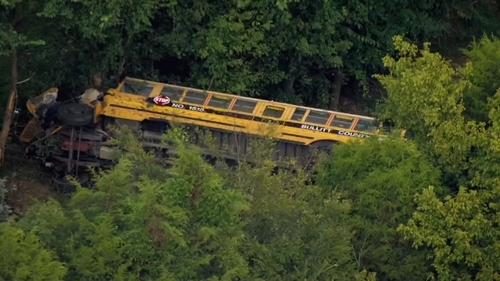
Source: ABC30 Fresno World. Casualplayhub News adds summary, context, and editorial framing while linking back to the original report.
A school bus carrying students rolled over on a rural road in Lebanon Junction, Kentucky, Monday afternoon, sending 14 people to area hospitals. The incident unfolded just after 4:30 p.m. local time, and emergency crews arrived to find the bus on its side, with debris scattered across the pavement. Fire Chief Adam Heath, a 24-year veteran of the county’s emergency services, described the scene as unprecedented in his career. “Not in my 24 years in this county,” Heath said, reflecting on the severity of the crash.
Among those on the bus was 15-year-old Cooper Brown, who recounted the harrowing moments leading up to the rollover. “Somebody was trying to pass somebody, kind of, and then the bus driver was trying to like pull over. And then like the wheel kind of broke; so the bus crashed,” Brown said. He added that his first thought after the bus came to a stop was how to assist his fellow students. “I told them that if there was enough room in my car for all of them, I could probably take them to their house if their moms and dads couldn’t come,” Brown said, demonstrating a sense of maturity beyond his years.
Aerial footage from local news stations showed the bus lying on its side in a grassy ditch, with emergency vehicles surrounding the area. The cause of the accident remains under investigation, but preliminary reports suggest a mechanical failure involving the wheel may have been a factor. The driver, whose name has not been released, was reportedly attempting to maneuver the bus to the side of the road when the wheel detached or broke, leading to the loss of control and the subsequent rollover.
Lebanon Junction, a small town in Bullitt County, is still grappling with the shock of the incident. Residents have been asking questions about road conditions, bus maintenance, and whether the driver had time to react differently. The school district has not yet issued a formal statement, but officials have confirmed that all students have been accounted for and that families have been notified. The 14 hospitalized individuals include both students and the driver, with varying degrees of injuries. None are believed to be life-threatening, but the exact conditions have not been disclosed.
This crash is part of a broader pattern of school bus accidents that have drawn attention nationwide. Earlier this month, a bus crash in Maryland injured over 30 people after a vehicle struck multiple cars and a building. While school buses remain one of the safest modes of transportation for children, these incidents highlight the vulnerabilities that exist, particularly on rural roads with limited shoulders and high speeds. The National Highway Traffic Safety Administration reports that, on average, about 130 people die each year in school-bus-related crashes, though most of those fatalities are not occupants of the bus but rather pedestrians or other motorists.
As the investigation continues, local authorities are urging anyone with dashcam footage or additional information to come forward. The bus has been towed for a mechanical inspection, and the results will likely determine whether any charges are filed or if policy changes are needed. For now, the community is focused on the recovery of those injured, with many expressing gratitude that the situation was not worse. Cooper Brown, for his part, is simply glad to be alive and able to help his friends. “I just wanted to make sure everyone was okay,” he said.
Article commentary
The school bus rollover in Lebanon Junction, Kentucky, is a stark reminder that even the safest vehicles can be involved in serious accidents. While the immediate cause appears to be a mechanical failure—specifically a wheel breaking—the broader context raises important questions about infrastructure, vehicle maintenance, and emergency preparedness in rural America. First, the incident underscores the challenge of maintaining aging school bus fleets. Many school districts across the country operate buses that are well beyond their recommended service life, with budgets often stretched thin. In Kentucky, as in other states, regular inspections are mandated, but the frequency and thoroughness can vary. A wheel failure suggests either a manufacturing defect or a lack of timely replacement of worn parts. If the investigation confirms a preventable mechanical issue, it will likely prompt calls for stricter oversight and more frequent safety checks. Second, the location of the crash—a rural road in Bullitt County—points to the unique dangers of driving on two-lane highways with limited shoulders. In such areas, a simple evasive maneuver to avoid a passing vehicle can quickly turn into a catastrophic event. The driver’s attempt to pull over was a reasonable response, but the lack of a safe shoulder or a designated pull-off area may have contributed to the severity of the rollover. This highlights the need for better road design and warning signs near school bus routes. Third, the response by emergency services and the quick thinking of students like Cooper Brown demonstrate the importance of community resilience. Brown’s instinct to offer help reflected a calmness that is not always present in traumatic situations. It also points to the value of school safety drills and first-aid training, which can empower students to act effectively in crises. From a policy perspective, this crash should serve as a catalyst for a broader conversation about school bus safety. While the National Highway Traffic Safety Administration has made strides in improving seat belt requirements and electronic stability control, real-world implementation remains uneven. Only a handful of states mandate seat belts on large school buses, and many rural routes still lack the physical infrastructure to protect against rollovers. Finally, the incident highlights the role of media coverage in shaping public perception. Aerial footage and eyewitness accounts can amplify fear, but they also provide crucial information for investigators and policymakers. The challenge is to balance transparency with sensitivity, especially when children are involved. In the end, the Lebanon Junction crash is a preventable tragedy that could have been far worse. The fact that no lives were lost is a relief, but it should not be an excuse for complacency. Every breakdown in safety—whether mechanical, human, or environmental—deserves a thorough review and, if necessary, systemic change. The community’s questions are valid, and they deserve answers that lead to safer roads for everyone.