NASA prepares to launch Roman telescope, exploring cosmic mysteries
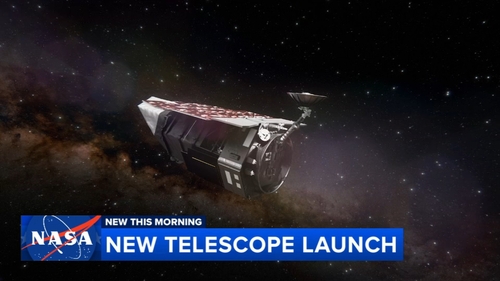
Source: ABC30 Fresno World. Casualplayhub News adds summary, context, and editorial framing while linking back to the original report.
NASA is on the verge of launching its next flagship space observatory, the Nancy Grace Roman Space Telescope, named after the agency’s first Chief of Astronomy. The telescope is scheduled to lift off as early as this weekend from Cape Canaveral, Florida, weather permitting. Scientists believe it will provide astronomers with a closer look at the far reaches of space than ever before, potentially revealing answers to some of the universe’s most profound mysteries.
The Roman telescope, previously known as the Wide-Field Infrared Survey Telescope (WFIRST), underwent a long and sometimes contentious development process. It was rebranded to honor Nancy Grace Roman, who played a pivotal role in the early days of NASA’s space astronomy program and was instrumental in the development of the Hubble Space Telescope. The telescope’s primary instrument is a 2.4-meter mirror, the same size as Hubble’s, but its wide-field camera captures a field of view 100 times larger, allowing it to survey the sky at an unprecedented pace.
Dr. Dominic Benford, a NASA scientist, will join Action News Mornings to discuss the mission’s potential. He is expected to highlight how the telescope will study dark energy, the mysterious force driving the accelerating expansion of the universe, by observing the shapes and positions of millions of galaxies. Additionally, the Roman telescope will conduct a microlensing survey to detect exoplanets, including free-floating planets not bound to any star. This capability could significantly expand our understanding of planetary systems.
The launch window opens this weekend, with exact timing dependent on final checks and weather conditions. Once in orbit, the telescope will travel to the Sun-Earth L2 Lagrange point, about 1.5 million kilometers from Earth, the same location as the James Webb Space Telescope. From there, it will begin a five-year primary mission, though its fuel is expected to last longer.
Astronomers are eager to see how Roman will complement Webb. While Webb focuses on deep, detailed observations of specific targets, Roman will conduct wide-area surveys, identifying interesting objects for follow-up study. This synergy could accelerate discoveries in galaxy evolution, dark matter, and the early universe. The mission also carries a technological demonstration of a coronagraph, which will block starlight to directly image exoplanets, paving the way for future missions.
The Roman telescope represents a major investment in American space science, with a budget of approximately $3.2 billion. It faced cancellation threats during earlier budget cycles, but Congress ultimately funded it. The launch is being managed by NASA’s Goddard Space Flight Center, with the Jet Propulsion Laboratory providing the coronagraph instrument.
As the launch date approaches, the scientific community holds high hopes. The telescope’s ability to gather vast amounts of data quickly could revolutionize fields from cosmology to planetary science. For NASA, it is a chance to continue the legacy of groundbreaking space observatories that have reshaped our understanding of the cosmos.
Article commentary
The upcoming launch of the Nancy Grace Roman Space Telescope marks a pivotal moment for NASA’s astrophysics program. As the agency’s next flagship observatory, Roman fills a critical niche between the deep-field capabilities of the James Webb Space Telescope and the wide-field surveys of ground-based observatories. Its design, centered on a large field of view, addresses a fundamental need in modern astronomy: the ability to survey large areas of the sky efficiently to identify rare phenomena and statistically significant samples. One of the most compelling aspects of the Roman telescope is its focus on dark energy. For over two decades, dark energy has remained one of the biggest puzzles in physics. Roman will measure the expansion history of the universe with unprecedented precision using weak gravitational lensing and baryon acoustic oscillations. This data could either confirm current models or reveal new physics. Similarly, the microlensing survey will provide a census of exoplanets across the galaxy, including those that are difficult to detect with other methods, such as planets in wide orbits or free-floating worlds. The naming of the telescope after Nancy Grace Roman is fitting. She was a trailblazer for women in science and a driving force behind Hubble. Her legacy is now carried forward by a telescope that embodies her vision of wide-field space astronomy. The coronagraph instrument, though a technology demonstration, shows NASA’s commitment to future direct imaging missions, possibly leading to a dedicated exoplanet observatory. However, the Roman telescope’s journey has not been without controversy. The project faced repeated budget overruns and political challenges, including a cancellation attempt by the Obama administration in 2014. Its survival reflects the strong support from the astronomical community and Congress, but it also highlights the difficulties of large-scale space missions. The reliance on a single launch window and the complexity of the coronagraph add risk. Looking ahead, Roman’s legacy will be defined by its discoveries. If it performs as expected, it will generate a flood of data, requiring new analysis techniques and community collaboration. The synergy with Webb will be particularly valuable, as Roman can identify targets for Webb’s exquisite spectroscopy. This combined approach could accelerate breakthroughs in understanding galaxy formation, the nature of dark matter, and the potential for life beyond Earth. In a broader context, the Roman telescope represents a strategic investment in American leadership in space science. It complements not only Webb but also future missions like the Vera C. Rubin Observatory on the ground. The coming decade promises a golden age of astronomy, with Roman playing a central role. As the launch date nears, the scientific community watches with anticipation, hoping that this telescope will live up to its promise and reveal secrets of the universe that have remained hidden for millennia.