Real and Entertaining: MSUM Dragons Showcase Small-College Football
Source: InForum Sports. Casualplayhub News adds summary, context, and editorial framing while linking back to the original report.
MOORHEAD — The sun cast long shadows across the green artificial turf of Alex Nemzek Stadium as the Minnesota State University Moorhead Dragons and Northern Michigan Wildcats loosened up for their Thursday evening kickoff. Athletic director Chad Markuson, standing near the sideline in the 79-degree warmth, watched the home team in white helmets and red jerseys move through drills. The visitors wore yellow helmets with all-white uniforms trimmed in green. A light breeze and a hip-hop soundtrack drifting from the speakers set the stage for a night that felt far removed from the billion-dollar machinery of the Football Bowl Subdivision.
When asked about revenue sharing and NIL money among the players on the field, Markuson smiled and shook his head. "We are very similar to the Big Ten," he deadpanned. "You just have to move the decimal point over a few places. Or more than a few. Maybe all the places." He chuckled. Was there a lawsuit brewing to get NFL players eligibility, LSU-style? Another chuckle. "I was in a group text with the other ADs this morning and I texted, 'We just found a judge. Jack Strand is eligible.' That got some responses."
Strand, the Dragons' former quarterback who is now on the cusp of making the Atlanta Falcons roster, would indeed be a coup for any Division II team. But the reality is that programs like MSUM are not immune to the modern pressures reshaping college football. Division I programs continue to poach players. Some schools in the Northern Sun Intercollegiate Conference are reportedly offering NIL deals. Even the beer garden beyond the north end zone hints at the changing times. Yet for those who lament the commercialization of the sport, there remains a pocket of "real" college football at this level.
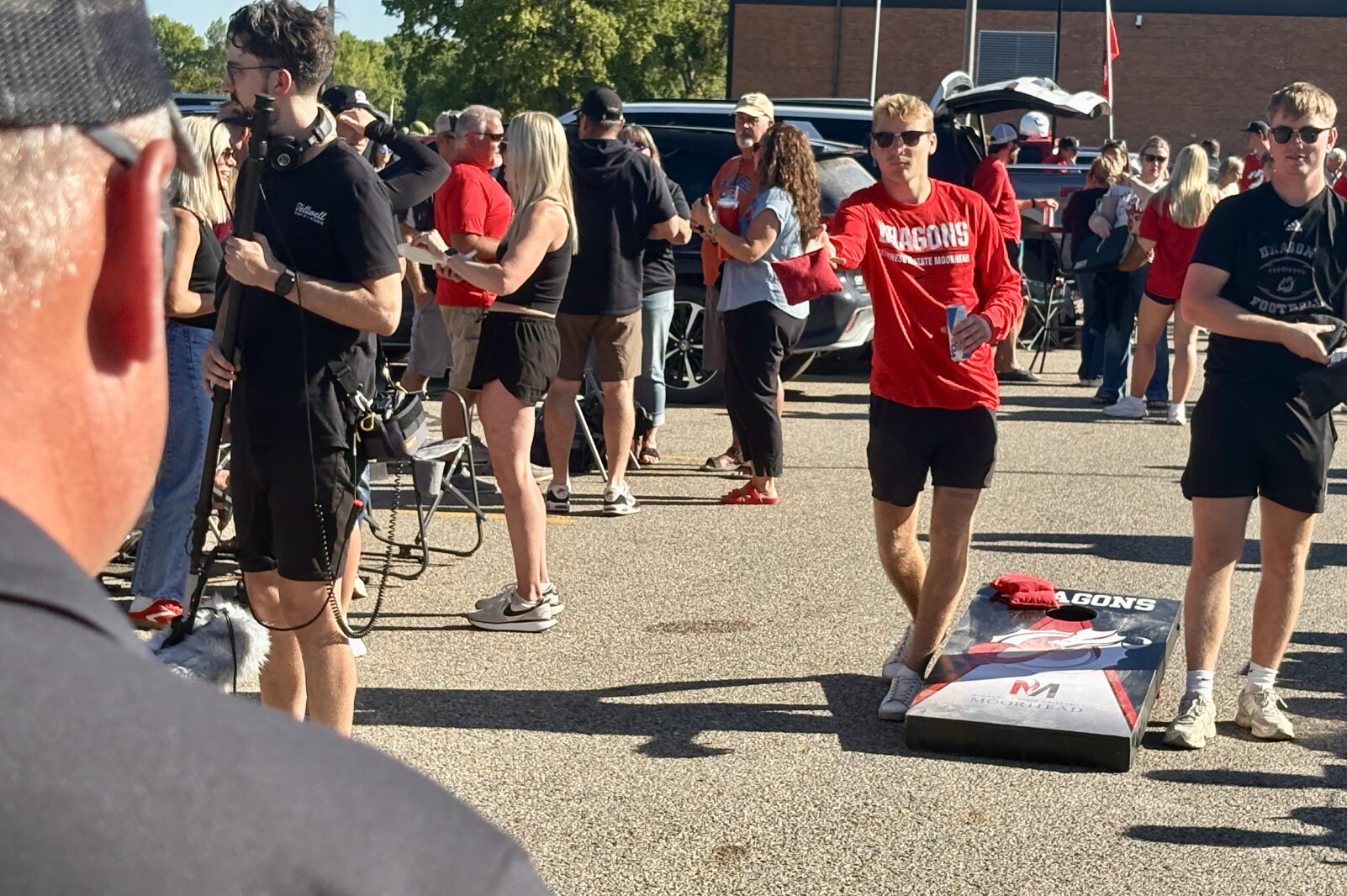
The Dragons and Wildcats provided a sample. The stands were filling, but not packed. The cost of a hot dog, chips, and a soda was just eight dollars. MSUM alum Brad Wimmer, wearing a red Dragons T-shirt and cap, summed up the appeal: "I'm thinking here and Concordia are going to be the best places to watch a college football game this year." He pointed to the contrast with the NFL, where rookies sometimes earn less than they did in college. "But Jack Strand is a great story, isn't he? That's quite a deal."
On the field, Strand's replacement, sophomore Drew Huebner from Morris, Minnesota, showed why the Dragons are optimistic. At 6-foot-4 and 245 pounds, he sprinted 73 yards for a touchdown in the second quarter, outrunning Northern Michigan's defensive backs to give MSUM a 14-3 lead. On the next possession, he displayed poise, waiting before firing a 20-yard pass over the middle to Kalen Lucas, who turned it into a 45-yard touchdown and a 21-3 advantage. The crowd roared — a reminder that the drama of college football is alive, even when the stakes are not national.
Wimmer reflected on the historical ties between the two programs. "NDSU and Northern Michigan used to play every year back in the 1980s. They banged heads in a lot of games. Interesting to see where each program ended up." A quick search confirms the Wildcats and Bison faced off 14 times, including 10 straight seasons from 1980 to 1989. Northern Michigan beat North Dakota State in 1987, a down year sandwiched between Division II national titles for the Bison. Now, NDSU is making the leap to the Football Bowl Subdivision, while Northern Michigan remains in Division II. On this Thursday, the Wildcats were being overrun early.
Entertaining college football is everywhere, but the kind that feels "real" — where the experience is about the game itself, not the circus around it — still exists. At Alex Nemzek Stadium, under the fading sun, the Dragons and Wildcats proved that point.
Article commentary
The article by Mike McFeely captures a crucial tension in modern college football: the growing chasm between the multi-billion-dollar industry of the Football Bowl Subdivision and the more modest, community-centered programs of Division II. By focusing on the Minnesota State University Moorhead Dragons, McFeely invites readers to consider what is lost when the sport becomes synonymous with NIL deals, conference realignment, and legal battles over player eligibility. One of the most striking elements is the self-deprecating humor of athletic director Chad Markuson. His joke about moving the decimal point "all the places" to compare MSUM's budget with the Big Ten underscores a fundamental truth: the financial gulf is not just wide but nearly insurmountable. Yet rather than lamenting this, Markuson leans into it, suggesting that programs like his can still offer a product that is authentic and entertaining. This authenticity is precisely what many fans claim to miss. The game-day experience at Alex Nemzek Stadium — cheap concessions, a modest crowd, a breeze carrying hip-hop music — stands in stark contrast to the corporate spectacle of a Power Five game. For the price of a single ticket at a major program, a family can enjoy an entire evening here. The article highlights that this is not a nostalgic retreat from modernity; the Dragons are still affected by the same forces. Players are lured away by NIL offers, and the beer garden is a concession to revenue. But the scale is different, and that difference matters. McFeely also touches on the shifting landscape of college football through the lens of history. The mention of North Dakota State's past rivalry with Northern Michigan, and NDSU's subsequent rise to the FBS, illustrates how quickly fortunes can change. The Bison's move to the Mountain West Conference is a boon for their university and community, but it also means leaving behind the kind of intimate, regional rivalries that defined the sport for decades. The Dragons, meanwhile, remain in a league where those connections still matter. From a broader perspective, the article serves as a reminder that college football is not monolithic. The attention given to the top tier often obscures the hundreds of programs that operate with far fewer resources. These schools provide opportunities for athletes who might not otherwise get a chance to play, and they serve as anchors for their communities. The emotional investment from fans like Brad Wimmer, who is decked out in Dragons gear, is no less genuine than that of a season-ticket holder at Ohio State. Insightfully, McFeely does not argue that one model is superior to the other. Instead, he presents a snapshot of a program that is navigating the currents of change while preserving what makes college football special. The Dragons' quarterback, Drew Huebner, running 73 yards for a touchdown, is a moment of pure athletic joy — untainted by endorsement deals or transfer portal speculation. That is the appeal of "real" college football. Ultimately, the commentary here is not a critique of the big-time game but a celebration of the diversity within the sport. As the college football landscape continues to evolve, programs like MSUM may become even more valuable. They offer a refuge for those who want to watch the game without the noise. And if the Dragons can keep producing stories like Jack Strand's, they will continue to draw fans who appreciate the simplicity of a Friday night under the lights.