Floating nuclear reactors aim for California ports, data centers
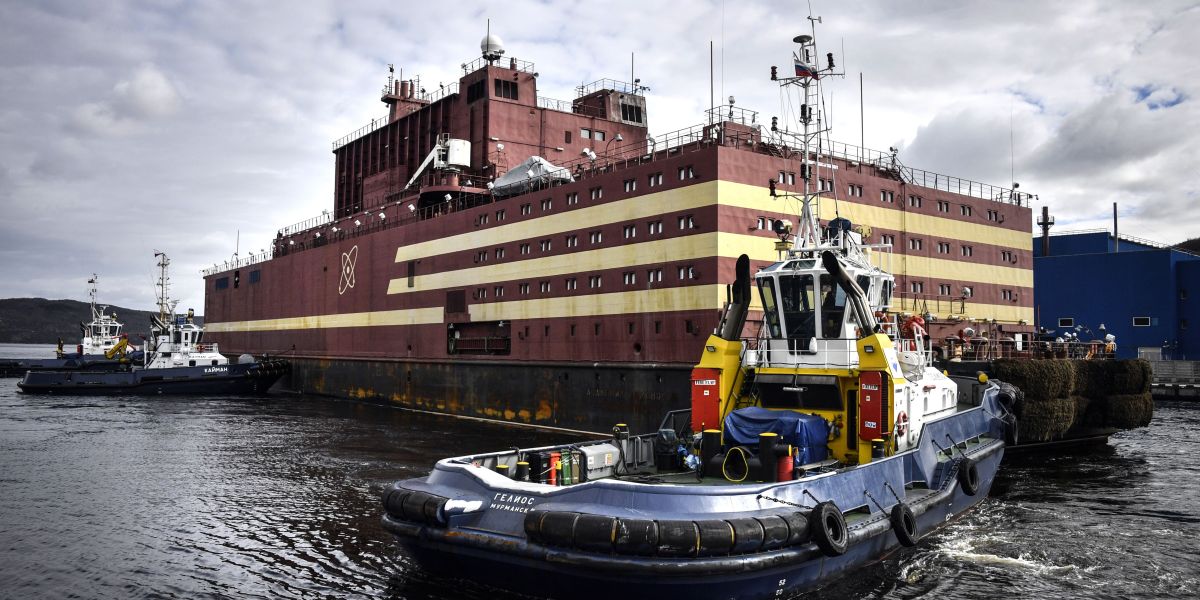
Source: Fortune. Casualplayhub News adds summary, context, and editorial framing while linking back to the original report.
Ad eligibility review: sensitive-topic
The United States is accelerating efforts to revive nuclear energy, aiming to fuel the booming AI data center industry and decarbonize maritime shipping. The next frontier: small modular reactors (SMRs) built on floating barges, positioned offshore to deliver clean power to coastal facilities and vessels. Surprisingly, this push may gain early traction in California, a state that has prohibited new nuclear power plants for nearly five decades.
This summer, the Port of Long Beach—part of the largest container port complex in the Western Hemisphere—inked an agreement with the Trump administration to explore next-generation SMRs. The goal is to generate emission-free electricity for the port itself, nearby data centers, and even cargo ships. While the concept of offshore nuclear power may sound novel, the U.S. Navy has operated small reactors on submarines and aircraft carriers for decades. In 2020, Russia deployed the world’s first floating nuclear power station on a barge to supply the remote Arctic town of Pevek, home to about 4,000 people.
Long Beach and neighboring Los Angeles handle a vastly different scale of trade. Their combined port complex is the busiest in the Western Hemisphere. The Port of Long Beach has partnered with Bluecore Energy, a startup founded only in January, to design SMRs on floating barges. The project remains several years from completion, but excitement is building.
“I think it’s very viable. It’s just a question of when, not if,” said Max Hopkins, a nuclear power analyst at CITIC CLSA, speaking broadly about the growth of offshore nuclear power across military, maritime, and AI data center applications. “To put something into place fast, with production means, and then you can just float it somewhere—it seems like offshore barges are going to be almost ideal. I think it’s going to become pretty accepted, much more so than people realize.”
Hopkins cautioned that the technology is still years from commercial deployment. Regulatory frameworks must be built, and supply chains and manufacturing systems need to mature. Beyond California, Denmark-based Saltfoss Energy is developing similar nuclear reactor barges in Europe.
The maritime sector is a significant contributor to global emissions. Cargo vessels account for about 3% of global greenhouse gas emissions—roughly equivalent to the entire continent of Africa. Nuclear propulsion could cut that drastically, as ships refuel every two or three years instead of every voyage, reducing fossil fuel use and enabling faster transit.
The federal government is pushing from multiple angles. This week, the U.S. Department of Transportation’s Maritime Administration (MARAD) announced a partnership with London-based Core Power to develop the regulatory and technical basis for a future fleet of nuclear-powered merchant ships. A day later, the U.S. and the International Atomic Energy Agency (IAEA) launched the Atomic Technologies Licensed for Applications at Sea (ATLAS) initiative, aiming to advance SMR and micro-reactor technologies for merchant shipping with strong safety and non-proliferation standards.
Bluecore’s founder and CEO, Kofi Asante, is a 31-year-old Ghanaian-American from Austin, Texas. He built his logistics expertise at Uber Freight, heavy-cargo drone company Elroy Air, and electric barge startup Arc. His vision: use the maritime industry to deliver clean, consistent power for ports and AI data centers. “The philosophy was really process of elimination: if you need that much energy, then you arrive at a nuclear reactor,” Asante told Fortune. “And if you need real estate, two-thirds of the world is water, so you can use barges for extra real estate.”
He added, “We can go miles away and connect via subsea cable—so we don’t have to be near neighborhoods, and we don’t have to be co-located at the port.”
Asante argues that the required technology is largely already developed, including smaller versions of traditional light-water reactors. Each 10-megawatt reactor on a barge can power roughly 10,000 homes, can be moved by tugboats, and can be stacked side by side to scale up generation.
The company is pursuing this path in a state that banned new nuclear reactors in 1976 over environmental and safety concerns, including unresolved radioactive waste issues. Port of Long Beach CEO Noel Hacegaba acknowledged the lengthy process, noting that state lawmakers are debating legislation to study lifting the ban. “Nuclear is having a moment at the Port of Long Beach, and we are engaged with the private sector, along with state and federal legislators on this issue,” Hacegaba said in a statement. “This innovation is years away from becoming a reality due to the technological advancements and regulatory hurdles that still need to be cleared, and it cannot advance without state and federal approvals. In the meantime, our new partners at Bluecore Energy are following state and federal laws as they provide the private-sector experience to research and develop SMR technology.”
Two big questions dominate the discussion: safety and economic competitiveness against natural gas and solar power. Asante draws a manufacturing analogy, arguing that older nuclear plants were built like custom factories—each one unique and expensive. “Small modular reactors like ours, you build multiple of them, so it starts to look like a factory,” he said. “Some of our team came from Rivian and Toyota, and we’re looking at it like a production facility.”
Hopkins supports the idea from a materials perspective: “A jet engine is actually much more complicated to build than a nuclear reactor from a materials science perspective.”
On safety, Hopkins noted that modern designs wrap uranium fuel pellets in multiple layers of ceramic and graphite, rendering them inert when separated. Asante emphasized that floating plants are mobile. “Our floating nuclear power plants are mobile. In the event of severe weather, they can quickly be repositioned. They are also shielded so that they can withstand extreme weather and be underwater. And we have multiple control mechanisms that will automatically turn the reactor off if needed.” He added that water itself is an advantage: “Water is the cooling mechanism and safest place for our systems, and we have an unlimited amount of access.”
Article commentary
The push for offshore nuclear power represents a fascinating intersection of technological ambition, regulatory reform, and energy demand. The idea of floating SMRs—essentially the same technology that has powered naval vessels for decades—offers a scalable solution to two pressing challenges: the insatiable appetite for electricity from AI data centers and the need to decarbonize maritime shipping. Yet the initiative’s launch in California, a state with a half-century-old ban on new nuclear plants, underscores the political and practical hurdles that remain. From a technical standpoint, the case for offshore nuclear is compelling. SMRs promise lower upfront costs, factory-style production, and the ability to site reactors away from populated areas. Being on water provides natural cooling and simplifies emergency planning. The military’s track record with nuclear propulsion is a strong proof of concept. However, the civilian regulatory environment is far more complex. The Nuclear Regulatory Commission has never approved a floating reactor design, and the existing framework for land-based plants may not apply directly. Regulatory inertia could delay projects for years, even if the political will exists. Economically, floating nuclear faces stiff competition from natural gas and renewable sources like solar and wind, especially when combined with battery storage. Natural gas is cheap and abundant, and solar costs have plummeted. Nuclear’s advantage is its reliability and density—it can provide constant power without intermittency. For AI data centers that require 24/7 operation, that reliability is a premium. But the levelized cost of electricity from SMRs remains uncertain until first-of-a-kind plants are built. The manufacturing analogy is promising, but mass production of nuclear reactors has never been achieved at scale outside of submarines. Safety concerns are not trivial. While modern reactor designs are far more robust than those of the 1970s, public perception of nuclear power remains deeply divided. The 2011 Fukushima disaster, which involved a tsunami overwhelming a coastal plant, still shapes public opinion. Proponents argue that floating reactors can be moved away from storms, but the possibility of accidents, terrorist attacks, or nuclear waste disposal issues persists. The industry will need to demonstrate extreme safety and transparency to gain community acceptance. Politically, California’s ban on new nuclear plants reflects a long-standing environmentalist opposition. Yet the state’s energy crisis—driven by intermittent renewables and rising demand from electrification and data centers—is forcing a reexamination. Some legislators are open to studying a repeal, but any change will likely require significant concessions on waste management and local control. The Port of Long Beach’s involvement lends credibility, but the project cannot move forward without state approval. On the federal level, the MARAD and IAEA collaborations signal a strategic push to position the U.S. as a leader in nuclear maritime technology. This aligns with broader goals of energy security and decarbonization. If successful, offshore nuclear could reduce emissions from shipping, which is notoriously hard to abate with batteries or hydrogen. The ATLAS initiative’s emphasis on safety and non-proliferation is crucial, as floating reactors could raise concerns about nuclear material being accessible to non-state actors. Ultimately, the future of offshore nuclear hinges on execution. The technology is ready, but the ecosystem—regulatory, manufacturing, and public acceptance—is not. The Bluecore project in Long Beach is a test case. If it can navigate the political and regulatory maze, it could pave the way for a new era of clean, reliable energy. If it stalls, it may be another reminder that nuclear power’s greatest obstacles are not technical but institutional. The next few years will be critical in determining whether floating reactors remain a niche novelty or become a mainstream solution.