Why Spoelstra's New Heat Roster Offers Clarity Over Chaos
Source: SI NBA. Casualplayhub News adds summary, context, and editorial framing while linking back to the original report.
Ad eligibility review: sensitive-topic
Erik Spoelstra has always preached the mantra of making the most of whatever roster he is given. It is a philosophy that has sustained him since taking over the Miami Heat in 2008-09, a tenure that now spans nearly two decades and stands as the longest not only in the NBA but across all major North American professional sports. Over the years, Spoelstra has navigated every conceivable team archetype: a squad built around a singular superstar like Dwyane Wade, a top-heavy constellation of celebrity talent during the Big Three era, a scrappy overachieving unit that roared to a 30-11 second-half record in 2016-17, and a volatile group led by the tempestuous Jimmy Butler. Yet the type of roster that has historically given him the most trouble is one with too many overlapping skill sets and no clear definition—a collection of B and B-minus players who do similar things without excelling at any one.
Last season offered a perfect illustration. When Norman Powell arrived from the Clippers, the hope was that he and Tyler Herro would form a dynamic scoring duo. Instead, Spoelstra found it far easier to achieve success when one of them was sidelined. The duplication of skill sets—both offensive-minded guards with defensive limitations—created a puzzle that resisted easy solutions. That is why the current roster, shaped by the departures of Powell to Chicago and Herro to Milwaukee, feels like a breath of fresh air for the coach. The new lineup is considerably less complicated and far more defined. Everyone knows exactly who the first option is: Giannis Antetokounmpo. Even during Butler’s best years, the pecking order was murky, with Herro, Bam Adebayo, and Goran Dragic trading 20-point nights, and Butler occasionally taking a back seat. Having a single alpha of Giannis’s caliber—a player who has ranked among the NBA’s five most efficient scorers for over a decade, including in the 36 games he played last season—eliminates that ambiguity. No one will overdribble or chuck while he camps near the paint. Spoelstra will make sure of that, and the roster contains no one inclined to challenge that hierarchy.
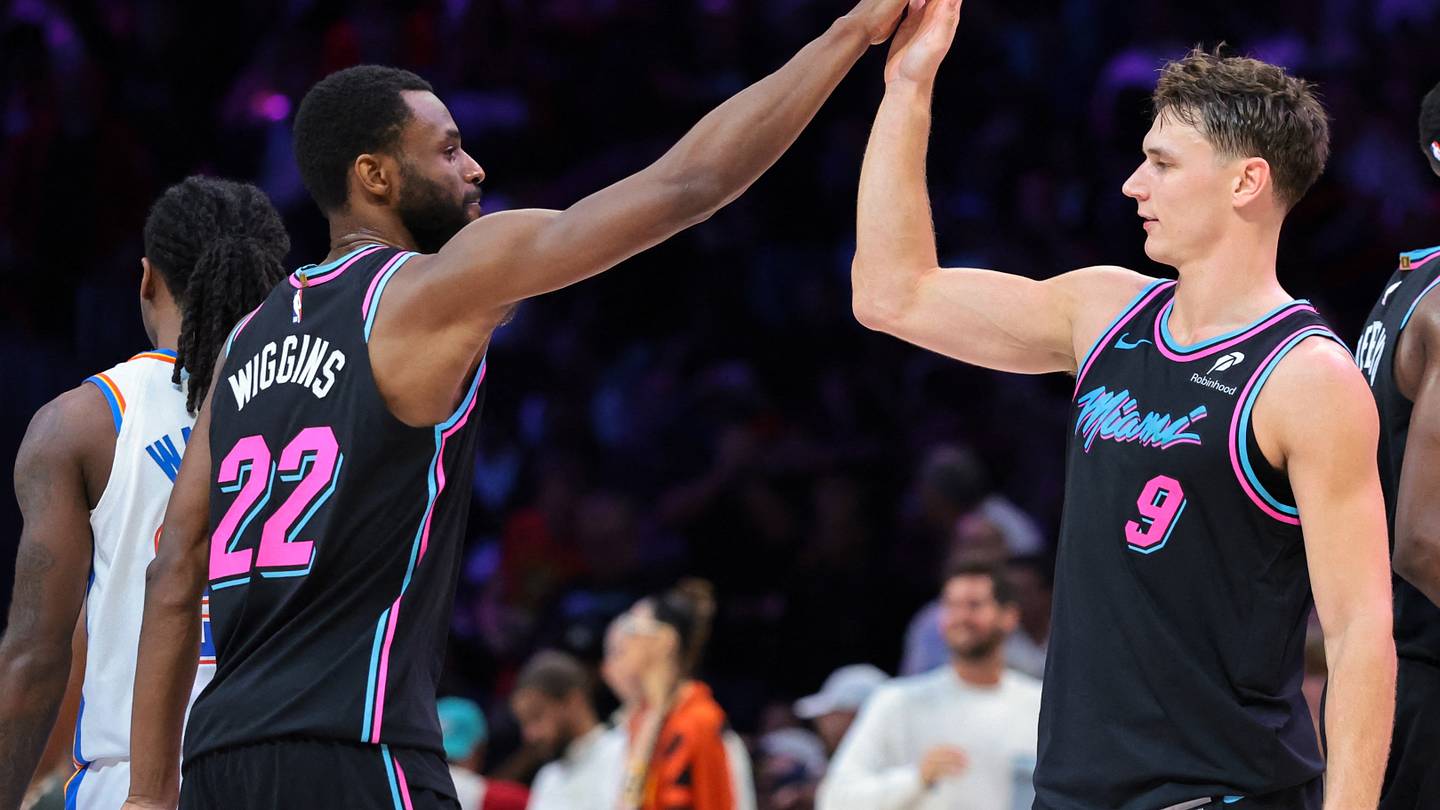
For the first time in years, the role of every Heat player is crystal clear. The roster appears to have been built with deliberate specialization. There are knockdown shooters: Klay Thompson, Tim Hardaway Jr., and Simone Fontecchio in a support role. Only Hardaway Jr. might be asked to do more than spot up behind the arc. There is a piercing cutter and dogged driver in Pelle Larsson, who has been thriving overseas and looks primed for another leap. There is a point-of-attack defender who has improved as a table-setter in Davion Mitchell. There is a relief scorer who will take the toughest wing defensive assignments, Andrew Wiggins, who has already won a championship in a similar role. There is the anchor of the defense, Bam Adebayo, who can occasionally drop 83 points and should find cleaner spots in the simplified pick-and-roll and dribble-hand-off-heavy offense—a departure from last season’s read-and-react system. There is a strip specialist in Dru Smith, capable of forcing havoc in short minutes until rookie Ryan Conwell is ready with his superior offensive skill set. There are two bigs who excel at one thing each: Bobby Portis Jr. as a stretch shooter who plays exceptionally well off Giannis, and Nick Richards as a relentless offensive rebounder.
The only real wild card is Nikola Jovic, who struggled to carve out a niche last season but has looked revitalized in international play. At just 23, he may be the preseason’s only project, and the Heat will hope to extract value from his new extension. But beyond him, every player has a clearly defined lane—one that makes it easier for Giannis to bully his way down the lane on offense while helping to clog it on defense. Variability is nice, but for a coach like Spoelstra, who has spent years navigating the chaos of overlapping talents, clarity and consistency may prove to be a far more valuable asset.
Article commentary
Erik Spoelstra’s journey through the NBA’s roster-building whims has always been defined by adaptation. From the star-studded Big Three era to the gritty, overachieving squads, his ability to extract maximum value from disparate parts has been his hallmark. Yet the challenge he faced last season with the Powell-Herro pairing revealed a fundamental truth: even the best coaches struggle when roles are blurry. The new Miami Heat roster, with Giannis Antetokounmpo as the undisputed fulcrum, represents a deliberate shift toward clarity. This is not merely about talent acquisition; it is about structural design. The Heat have traded the complexity of interchangeable scorers for the simplicity of defined specialists. Spoelstra, a coach who thrives on system and order, is likely to find this environment far more conducive to his strengths. What makes this roster particularly intriguing is the removal of ambiguity in the pecking order. During the Butler years, the offense often oscillated between multiple lead options, creating moments of indecision. With Giannis, the hierarchy is non-negotiable. His gravitational pull on defenses will open up the floor for shooters like Klay Thompson and Tim Hardaway Jr., while his ability to draw double teams will create space for cutters like Pelle Larsson. The supporting cast, from Davion Mitchell’s defensive tenacity to Andrew Wiggins’ two-way versatility, is built to complement rather than compete. Even Bam Adebayo, who has occasionally struggled to find his role in the offense, should benefit from a system that highlights his pick-and-roll and dribble-hand-off skills rather than the read-and-react complexity of last season. However, this roster is not without its risks. The reliance on specialists means that if one key player is injured—say, Giannis or Klay Thompson—the system could break down. The Heat lack a secondary ball-handler with the same caliber as the departed Herro or Powell, leaving Davion Mitchell and Pelle Larsson to shoulder playmaking duties. Nikola Jovic remains a wild card; his development could either fill a gap or become a lingering question mark. Additionally, the defensive chemistry of a unit that includes multiple new faces will take time to coalesce. Spoelstra’s reputation for building culture and accountability will be tested early in training camp. From a broader perspective, the Heat’s roster construction reflects a league-wide trend toward specialization. In an era where positionless basketball is often celebrated, there is a countervailing need for clarity. The Milwaukee Bucks’ success with Giannis has long been built on a similar model—a dominant star surrounded by role players who know their jobs. By replicating that blueprint, Miami is betting that Spoelstra’s coaching acumen can turn a collection of clear roles into a cohesive unit. The variability of previous seasons may have been exciting, but for a coach who has seen it all, consistency and clarity are likely the tools that will unlock the team’s true potential. The first few weeks of camp will reveal whether this bet pays off.