Scheffler Claims Second FedEx Cup, Surpasses Woods in Earnings
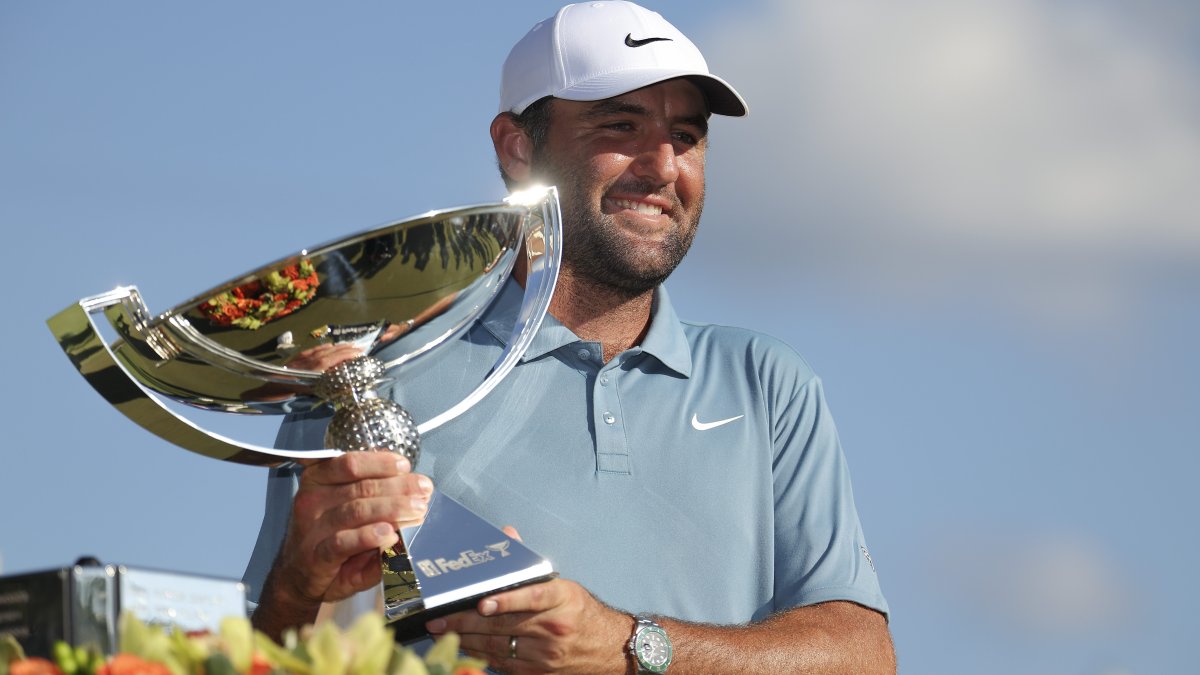
Source: NBC Chicago Sports. Casualplayhub News adds summary, context, and editorial framing while linking back to the original report.
Ad eligibility review: sensitive-topic
Scottie Scheffler ended any lingering debate about who dominated the PGA Tour this season, storming back from a three-shot deficit with a 4-under 66 to win the Tour Championship on Sunday. The victory delivered his second FedEx Cup title and propelled him past Tiger Woods for the most career earnings in PGA Tour history.
Scheffler’s charge began with a signature moment on the 211-yard second hole. Facing a long iron into a green, he unleashed a 5-iron that landed softly and rolled to within two inches of the cup, setting up a tap-in birdie. That shot signaled the start of a relentless rally. He caught Viktor Hovland with a 25-foot birdie putt on the fourth hole, then pulled ahead for the first time on the 13th. From there, he managed the course with composure, holding off Hovland’s challenge to secure the win at East Lake Golf Club.
“This was a week I brought a lot of good energy to the course and tried to do my best,” Scheffler said during the trophy presentation. “Coming from behind and being able to win tournaments is a really cool feeling.”
The victory marked Scheffler’s third title of the year, and his second in the last three weeks of the PGA Tour’s postseason. He matched Chris Gotterup, Matt Fitzpatrick, and U.S. Open champion Wyndham Clark for the most wins in 2026. Scheffler first won the FedEx Cup two years ago, and his consistency has been remarkable. Players vote on the Jack Nicklaus Award for PGA Tour Player of the Year, and Scheffler has won the last four years. Another victory would tie him with Woods for the most consecutive awards.
Taking over the top spot in career earnings was inevitable given the massive purses now on offer. The Tour Championship’s $40 million purse now counts as official money, and Scheffler’s $10 million first-place check boosted his career total to $130,390,661. Woods, who never played for more than a $10 million purse during his peak years from 1997 through 2008, had held the top spot on the money list for nearly 26 years.
For Scheffler, the win also provided a small measure of redemption. He had lost a playoff to Hovland at the Travelers Championship earlier this year, one of five runner-up finishes in his season. Hovland, who made only one birdie and closed with a 72, finished alone in second, earning $5 million. Scheffler’s round included two bogeys—one from a poor wedge shot on the seventh hole, the other from a difficult lie in the rough on the 14th—but he was the only player in the final three groups to break par. His final birdie came from a fairway bunker, hitting to 11 feet on the 16th hole.
Hovland’s frustration was evident as he saw three putts in a four-hole stretch catch the lip of the cup—two for birdie, one for par. Ryan Gerard, who started the day one shot behind Hovland, made a double bogey on the opening hole, then recorded 13 consecutive pars before finishing with a 72 to take third place alone.
Scheffler, who won his season opener at The American Express, ended the year with the 22nd title of his career—13 of those victories by at least three shots—and 25th worldwide, including an Olympic gold medal in Paris two years ago. The Tour Championship brings together the top 30 players in the FedExCup standings for the final event of the PGA Tour’s FedExCup Playoffs. Scheffler’s performance underscored his dominance, leaving no doubt about who reigned supreme in 2026.
Article commentary
Scottie Scheffler’s victory at the Tour Championship and his second FedEx Cup title cement a season that will be remembered for its consistency and resilience. But beyond the trophy and the $10 million check, the win carries broader implications for the PGA Tour’s narrative, the evolution of player earnings, and the competitive landscape heading into the next season. Scheffler’s rise to the top of the career money list—surpassing Tiger Woods—is a symbolic milestone that reflects the changing economics of professional golf. Woods, who dominated from 1997 through 2008, never played for purses that routinely exceed $20 million, let alone the $40 million on offer at the Tour Championship. Scheffler’s career earnings of $130,390,661 are a product of the sport’s financial boom, driven by the PGA Tour’s increased investment in prize money, the emergence of the FedEx Cup playoffs, and the pressure from rival leagues. Yet the comparison is not just about dollars. Woods’s legacy was built on sheer dominance and cultural impact, while Scheffler’s consistency—13 of his 22 wins came by at least three shots—suggests a different kind of dominance: one that thrives on methodical excellence rather than explosive flair. The season also highlighted the growing rivalry between Scheffler and Viktor Hovland. Their playoff at the Travelers Championship earlier this year was a thriller, and Hovland’s strong performance at East Lake—finishing alone in second despite a closing 72—shows he is a persistent challenger. The contrast in styles is intriguing: Scheffler’s precision and short-game wizardry versus Hovland’s power and ball-striking. If Hovland can tighten his putting and avoid the occasional lip-outs that cost him at East Lake, he could become a more serious threat in future postseason battles. Scheffler’s ability to rally from behind is another hallmark of his game. This win was his 22nd career title, and 13 of those came from deficits of at least three shots. That resilience, combined with his calm demeanor under pressure, makes him the player to beat in any tournament. Yet the season also revealed some vulnerability. His five runner-up finishes, including the playoff loss to Hovland, suggest that while he is consistently near the top, he is not invincible. The margin for error in the modern game is razor-thin, and the depth of talent on the PGA Tour means that any player in the top 30 can win on a given week. Looking ahead, Scheffler’s fourth consecutive Jack Nicklaus Award seems almost certain, and a fifth would tie Woods’s record. But the bigger question is whether the PGA Tour’s postseason format will continue to produce compelling narratives. The Tour Championship’s staggered-start system, designed to reward regular-season performance, has been criticized for creating artificial drama. Scheffler’s comeback from a three-shot deficit, while exciting, may not fully satisfy purists who prefer a clean slate. The tour will likely face pressure to tweak the format, especially if one player—like Scheffler—dominates consistently. Finally, Scheffler’s Olympic gold medal in Paris two years ago adds a global dimension to his resume. He is not just a PGA Tour star; he is an international ambassador for the game. As the sport continues to navigate the rift between the PGA Tour and LIV Golf, having a universally respected champion like Scheffler provides a stabilizing force. His quiet professionalism and focus on the game itself, rather than the politics, may be his most valuable asset. For now, Scheffler is the undisputed king of the season, and the conversation about who had the best year is officially closed.