France's Presidential Hopeful Proposes Debt Cancellation: 'Chuck It in the Fire'
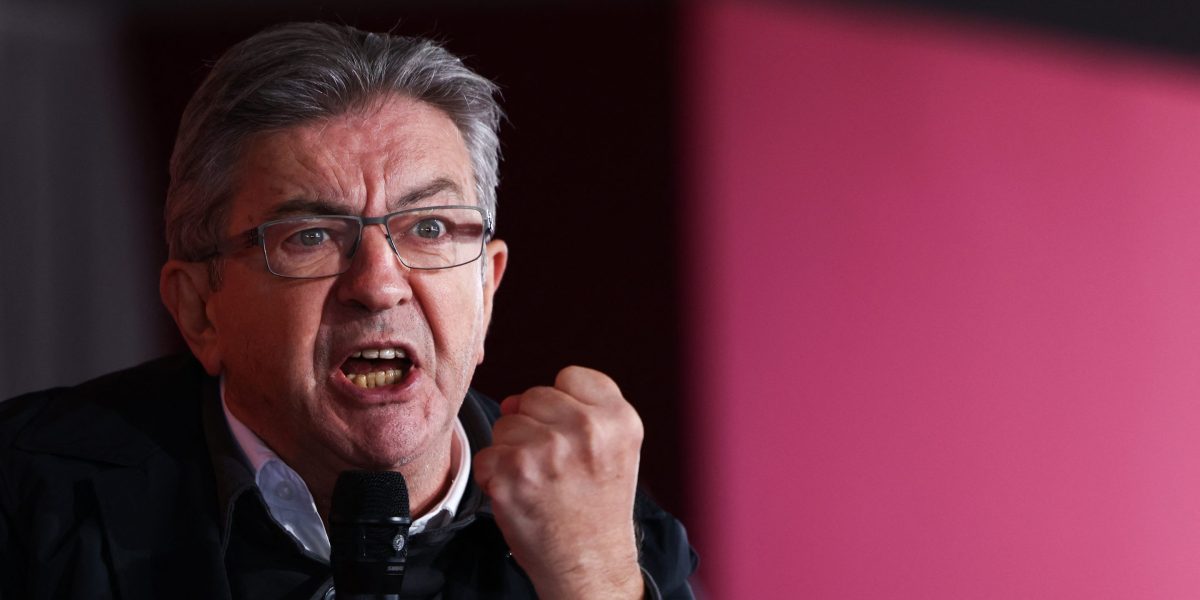
Source: Fortune. Casualplayhub News adds summary, context, and editorial framing while linking back to the original report.
While American politicians focus on data centers, gas prices, and the Iran conflict during midterm campaigns, France's presidential race is grappling with a far more fundamental question: how to handle a towering national debt that now exceeds 116% of GDP. The contrast is striking. The U.S. national debt has hit $40 trillion, yet it barely registers as a campaign talking point. In France, however, the issue dominated a recent presidential debate, and one candidate has offered a radical solution that is capturing public imagination.
Jean-Luc Melenchon, the leader of the far-left France Unbowed party, is campaigning on a plan that sounds almost too simple: have the Bank of France cancel the 18% of French debt it holds. "All we have to do is take the 18% held by the Bank of France and chuck it in the fire," he has declared. The idea, he argues, would lighten the debt burden and allow the government to ramp up spending on social programs without resorting to austerity. Economic growth in France has been sluggish, and the AI boom that is supercharging America's GDP has largely bypassed the eurozone's second-largest economy. Melenchon's message is resonating with voters tired of belt-tightening; polls indicate he is on track to face far-right leader Marine Le Pen in the second round of next year's presidential election.
But the proposal has drawn sharp warnings from financial and political circles. France's own prime minister has cautioned that reneging on the debt would force the government to borrow at exorbitant interest rates, especially as it needs to raise more than $360 billion from bond markets this year. Melenchon insists his plan is different because it targets only central bank holdings, not private creditors. Yet at a recent campaign event, he hinted at a broader ambition. "Why did we make a single currency and an ECB together? We can do it, and I bet we'd find allies in Europe," he said, adding, "There is a debate — I'm not going after private creditors, not at this step in any case."
Germany's central bank chief, Joachim Nagel, who also sits on the European Central Bank's Governing Council, was unequivocal in his response. "No central bank in the Eurosystem nor the ECB is allowed to cancel national debt," he told French newspaper Le Monde. "This would constitute monetary financing of government, which is prohibited under the European treaties." The warning underscores the legal and institutional barriers to Melenchon's plan. Even if he were to win the presidency, any attempt to cancel debt would face fierce opposition from Germany and other eurozone members.
Meanwhile, bond markets are already pricing in risk. The yield on French 10-year bonds has risen to about 88 basis points above equivalent German yields, approaching the highest spread since the eurozone debt crisis in 2012. The spread is a key gauge of investor confidence, and Kristian Kerr, head of macro strategy for LPL Financial, noted that 90 basis points has historically acted as a ceiling during periods of fiscal stress. In a recent note, he warned that if the spread decisively breaks above that level, it could signal that investors view France's fiscal challenges as structural rather than cyclical. "That shift would matter well beyond France," Kerr wrote. "European and global sovereign debt markets remain highly interconnected, and a material deterioration in confidence toward French debt could easily spill over into other countries with weaker fiscal profiles."
Adding to the uncertainty is the lack of a parliamentary majority willing to support budget cuts. France's deficit stands near 5% of GDP, well above the European Union's 3% target, a source of persistent bond market anxiety. Melenchon's proposal, while popular with voters, does not address the underlying need for fiscal consolidation. Instead, it offers a one-time solution that, if implemented, could trigger a broader crisis of confidence in the eurozone's institutional framework. The coming months will test whether the electorate is willing to embrace such a gamble or prefers more orthodox approaches to managing the nation's debt.
Article commentary
Jean-Luc Melenchon's proposal to cancel French debt held by the central bank is a political bombshell that reflects deep frustration with the status quo. While the idea may seem radical, its appeal lies in its simplicity: a one-time act of accounting that would instantly reduce the public debt burden and free up resources for social spending. For a country where economic growth has been anemic and inequality persistent, the promise of a fresh start without austerity is understandably attractive. Polls showing Melenchon heading for a runoff suggest that the French electorate is increasingly open to unconventional solutions. Yet the proposal is fraught with risks that extend far beyond France's borders. The prohibition on monetary financing is a cornerstone of the European Union's legal framework, designed to prevent central banks from bailing out profligate governments. If France were to ignore that rule, it would not only violate treaties but also undermine the credibility of the eurozone as a whole. Joachim Nagel's warning is not just a legal opinion; it is a signal that Germany and other creditor nations will resist any attempt to rewrite the rules retroactively. The spread between French and German bond yields has already widened to near-crisis levels, indicating that investors are taking the threat seriously. A decisive breach of the 90-basis-point threshold could trigger a sell-off that spreads to other vulnerable economies like Italy and Spain, reigniting the kind of contagion that nearly broke the eurozone in 2012. What makes Melenchon's plan particularly dangerous is its ambiguity. He has hinted that debt cancellation might not stop at the central bank, raising the prospect of a cascading repudiation that could include private creditors. Even if he were to limit the move to the Bank of France, the signal it sends to financial markets would be devastating. Investors would demand higher yields to compensate for the risk of future expropriation, driving up borrowing costs for the French government and potentially crowding out private investment. The prime minister's warning about exorbitant interest rates is not hyperbole; it is a realistic assessment of how markets would react to a unilateral default, however partial. On the other hand, the debate highlights a genuine problem: the eurozone's fiscal rules are often seen as rigid and punitive, leaving little room for countries to invest in growth or social welfare. Melenchon's rhetoric taps into a widespread sentiment that the EU's austerity orthodoxy has failed to deliver prosperity. Yet the solution is not to tear up the rulebook but to reform it in a way that balances fiscal discipline with the flexibility to address cyclical downturns. The European Commission has already relaxed the Stability and Growth Pact to allow for more investment, but the pace of reform is too slow for voters who are impatient for change. Ultimately, Melenchon's proposal is more a symptom of the crisis than a cure. It reflects a loss of faith in mainstream economics and political institutions, a trend visible across many Western democracies. Whether France will actually embrace such a radical step remains to be seen. The bond market's jitters suggest that the cost of doing so could be steep, and the legal barriers are formidable. But the fact that such an idea is being seriously discussed in a presidential campaign is a sign that the debate over debt and sovereignty is far from over. The outcome of next year's election will have profound implications not just for France, but for the entire eurozone project.