U.S. Women Survive Italy 55-52 in FIBA World Cup Nail-Biter
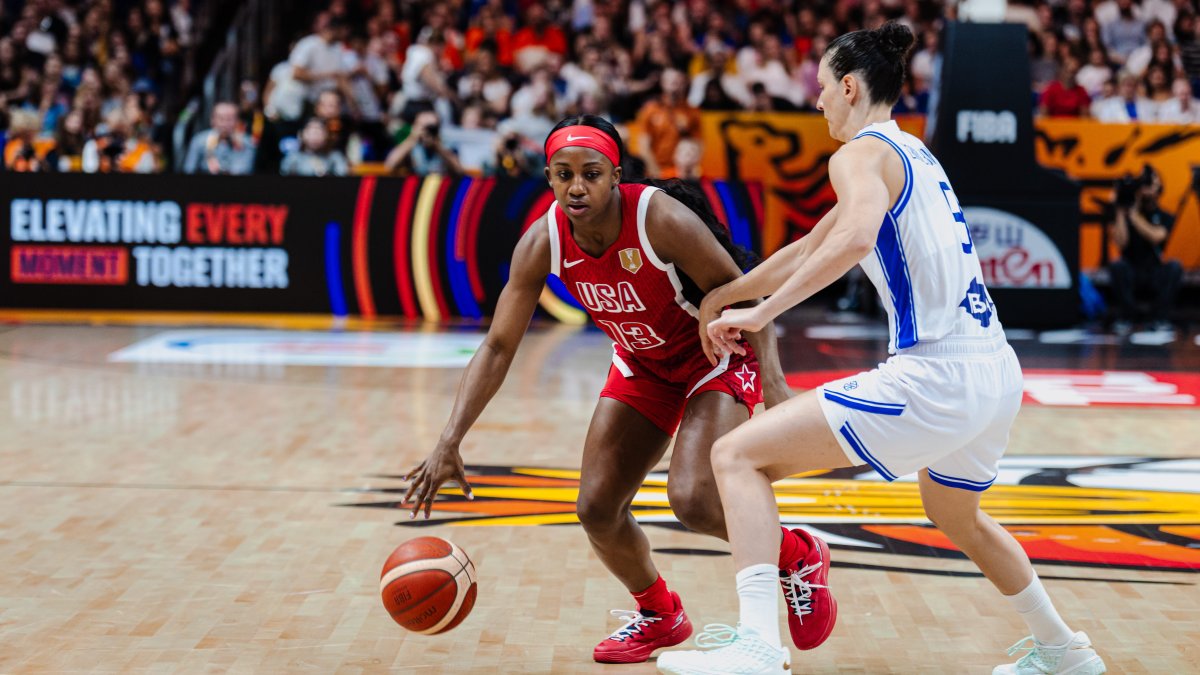
Source: NBC10 Philadelphia Sports. Casualplayhub News adds summary, context, and editorial framing while linking back to the original report.
The United States women's basketball team has dominated the international stage for decades, but on a tense Sunday evening in Berlin, they had to dig deeper than any World Cup game in nearly 20 years. Escaping with a 55-52 victory over Italy, the Americans learned that even the most storied programs can be pushed to the brink.
Jackie Young led a sputtering offense with 10 points, but the box score tells only part of the story. The 55 points marked the lowest total for a U.S. win in the World Cup since a 42-38 grind against Australia in 1967. For a team that had won 32 consecutive World Cup games—dating back to a 2006 semifinal loss to Russia—this was uncharted territory.
Italy, playing in its first World Cup since 1994, threw a wrench into the American machine with a disciplined 2-3 zone defense. The U.S. shot just 29% from the field, missed all but one of their 12 three-point attempts, and failed to convert numerous layups. “Obviously, Italy really kind of mucked up the game for us a little bit,” said Breanna Stewart, who missed her first eight shots before scoring the go-ahead basket with less than four minutes to play. “They are a tough team. Tons of respect to what they’ve done.”
The game began as so many U.S. contests do: a dominant first quarter that saw the Americans sprint to a 23-8 lead. But Italy adjusted, switching to a zone that disrupted the U.S. rhythm. The Italians closed the half on a 16-7 run, trimming the deficit to 30-24. They carried that momentum into the third quarter, an 11-2 surge giving them a 35-32 lead. By the fourth, it was 50-48 Italy with 4:29 remaining.
Then came the turning point. Chelsea Gray, known for her savvy, drew a charging foul on Italy's Matilde Villa with 3:03 left, a call Coach Kara Lawson described as “a big momentum-changing play.” Gray followed with a jumper with 1:07 on the clock, pushing the U.S. lead to five. Villa answered to cut the margin to three, but Italy's final chance—a three-pointer by Cecilia Zandalasini at the buzzer—clanked off the rim.
Zandalasini, who led Italy with 14 points, later apologized for her emotional reaction toward an official after the no-call. “I would like to apologize for how I reacted in the end,” she said. “It was a lot of emotions today, but I should have kept them inside of me a little better.”
For the U.S., the narrow escape was a reminder of a shifting landscape. The Americans’ eighth consecutive Olympic gold in 2024 came by a single point against France. “We’ve seen that through the tournament that every game feels like a dogfight,” Lawson said. “It’s really hard. On any given night, if you’re not prepared to play, you’ll lose. That’s awesome for our sport.”
Elsewhere on Sunday, China edged the Czech Republic in overtime, Australia topped Turkey, and Belgium beat Puerto Rico. The U.S. (2-0) will need to recalibrate its offense quickly as the tournament progresses. “You have to be able to win different ways,” Lawson added. “We didn’t have a fastball tonight, but we figured it out late and we’ll grow from it.”
Article commentary
The United States’ 55-52 survival against Italy at the FIBA Women’s World Cup is more than a narrow victory—it is a signal of a paradigm shift in international women’s basketball. For years, the U.S. team has been an almost mythical force, a juggernaut that steamrolled opponents by margins that often exceeded 30 points. That aura of invincibility took a significant dent on a Sunday night in Berlin, not because the Americans played poorly—though they did—but because Italy played exceptionally well. Italy’s game plan was masterful. They employed a collapsing 2-3 zone that forced the U.S. into uncomfortable perimeter shots and contested finishes at the rim. The Americans, who pride themselves on fluid ball movement and transition offense, looked stagnant. They shot 29% from the field, made only one of 12 three-pointers, and missed several easy layups. This was not merely a bad night; it was a systematic neutralization by a disciplined European team that had studied the U.S. vulnerabilities exposed in the 2024 Olympic gold medal game, where France came within a single point. The broader narrative here is the closing gap. The U.S. has won 32 straight World Cup games, but the margins have been shrinking. Before Sunday, the last single-digit win in a World Cup came in 2010 against Australia (an eight-point margin). Italy, a team that lost to the U.S. by 34 points in a qualifier earlier this year, nearly flipped that script. This is not an anomaly—it is a trend. More nations are investing in coaching, player development, and tactical sophistication. The rise of WNBA players representing other countries, combined with better preparation by national federations, has created a deeper pool of competitive teams. Chelsea Gray’s drawn offensive foul in the final minutes was emblematic of the kind of veteran savvy that still separates the U.S. from the rest. But relying on such individual moments of brilliance is not a sustainable strategy. The team’s offensive rhythm collapsed under Italy’s zone, and the absence of a consistent three-point threat—a longstanding U.S. weakness—was glaring. Coach Kara Lawson acknowledged the need to win “different ways,” but the question lingers: can this team adapt quickly enough as the tournament progresses? For Italy, the performance was a testament to their growth. Cecilia Zandalasini emerged as a genuine star, and the team’s composure in the face of a 15-point deficit was remarkable. Their emotional reaction at the buzzer, including Zandalasini’s apology for her outburst, shows how much this game meant. They are no longer a footnote in international basketball; they are a contender. As the U.S. moves forward, the rest of the world will take note. The blueprint to challenge the Americans now exists: slow the pace, pack the paint, and force them into half-court sets. Whether the U.S. can adjust—or whether this is the beginning of a more competitive era—remains to be seen. One thing is certain: the days of automatic blowouts are over.