First Road Bridge Opens Between Russia and North Korea
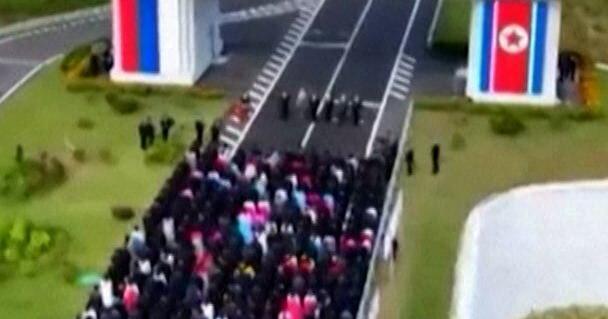
Source: Press of Alantic City Business. Casualplayhub News adds summary, context, and editorial framing while linking back to the original report.
A new era in Russia-North Korea relations was physically cemented this week with the opening of the first road bridge connecting the two countries. The crossing, built over the Tumen River near the border, dramatically enhances overland connectivity between the Russian Far East and North Korea. Until now, the only direct link was a railway bridge, which has been used sparingly due to capacity constraints and political tensions. The road bridge is expected to significantly boost bilateral trade, which has been on the rise as both nations face sweeping sanctions from the United States, the European Union, and their allies.
The project reflects a broader strategic alignment that has accelerated since Russia's full-scale invasion of Ukraine in 2022. Moscow, desperate for ammunition and military hardware, has reportedly turned to Pyongyang for artillery shells, missiles, and other conventional weapons. In return, North Korea has sought food, energy, technology, and diplomatic backing to alleviate the pressure of UN Security Council sanctions. The bridge offers a tangible infrastructure for these exchanges, reducing reliance on maritime routes that are more vulnerable to interception.
Local officials in Russia's Primorsky Krai region have hailed the bridge as a boon for economic development. They envision increased cross-border tourism, easier movement of labor, and expanded agricultural trade. North Korea, meanwhile, sees the link as a lifeline to a powerful ally that can help modernize its dilapidated infrastructure and provide a buffer against Chinese dominance. For decades, Pyongyang relied almost exclusively on Beijing for diplomatic and economic support. The deepening ties with Moscow give North Korea greater leverage, allowing it to play two large neighbors against each other.
Military implications are also palpable. The road bridge can handle heavy vehicles, including trucks carrying military supplies. Intelligence reports have already documented a surge in rail traffic between Russia and North Korea, with satellite imagery showing covered wagons and military-grade containers. The new road bridge could facilitate even faster deliveries, potentially evading some international monitoring. South Korea and Japan have expressed concerns, while the United States has warned that any arms transfers would violate multiple UN resolutions.
The timing of the opening is notable. It comes shortly after a summit between Russian President Vladimir Putin and North Korean leader Kim Jong Un in Pyongyang, where the two signed a comprehensive strategic partnership treaty that includes a mutual defense clause. The bridge serves as a concrete manifestation of that pact, transforming a paper agreement into a physical artery of cooperation.
Observers note that the bridge also has symbolic weight. It stands as a direct challenge to the international sanctions regime, demonstrating that the two pariah states can still forge major infrastructure projects without Western approval. The structure is relatively modest in scale—likely a two-lane crossing—but its political significance far exceeds its physical footprint.
For local populations on both sides, the immediate benefits may be limited. The North Korean side of the border remains heavily militarized, and free movement is tightly controlled. However, the bridge is seen as a preliminary step toward broader integration, possibly including energy pipelines and railway upgrades. Both governments have invested significant resources, signaling a long-term commitment to the partnership.
The international response has been cautious. China, while officially supportive of its neighbors' cooperation, is watching closely. Any Moscow-Pyongyang axis that reduces Beijing's influence in North Korea could complicate Chinese regional strategy. Meanwhile, the European Union has hinted at additional sanctions targeting infrastructure projects that sustain Russia's war effort. Yet enforcement remains difficult, as the bridge lies in a remote area far from international scrutiny.
In the coming months, traffic across the bridge is expected to ramp up gradually. Initial cargoes are likely to include food, construction materials, and machinery from Russia, exchanged for North Korean munitions and minerals. The bridge’s opening marks a new chapter in a relationship born of necessity, but one that is rapidly evolving into a full-fledged alliance.
Article commentary
The inauguration of the first road bridge between Russia and North Korea is more than just an infrastructure achievement—it is a geopolitical statement. As the two nations deepen their embrace amid global isolation, this crossing physically embodies a partnership that now spans security, economics, and diplomacy. The bridge allows for faster and more reliable movement of goods and people, which is particularly significant given the tightening noose of Western sanctions. For Russia, the link provides a direct umbilical cord to a supplier of munitions and artillery, resources that are crucial for sustaining its war in Ukraine. For North Korea, the bridge offers a gateway to Russian energy, food, and technology, while also serving as a strategic counterweight to China’s overwhelming influence. The strategic calculus behind the bridge reflects a broader trend of cooperation among states that share an adversarial stance toward the U.S.-led international order. Russia and North Korea are both under heavy sanctions; both have been condemned by the United Nations; and both seek to project an image of resilience and self-sufficiency. The bridge is a tangible demonstration that they can still engage in substantial development projects without Western support. This challenges the effectiveness of sanctions as a tool of foreign policy, a point that analysts are likely to debate for years. From a security perspective, the bridge raises alarm bells in Seoul, Tokyo, and Washington. The ability to transport military hardware over land reduces the risk of interception at sea and speeds up logistics. Intelligence agencies will now have to monitor this new chokepoint, which adds to the complexity of tracking arms flows. Moreover, the bridge complicates any future efforts to interdict supplies to Russia’s military. The mutual defense clause signed recently means that an attack on one could trigger a response from the other, potentially drawing North Korea into a conflict on Russia’s side. Yet the bridge also carries risks for both countries. Greater connectivity means greater interdependence, which could become a vulnerability if relations sour or if one side defaults on commitments. North Korea’s regime is notoriously unpredictable, and Russia’s wartime economy may not be able to sustain long-term infrastructure investments. Additionally, the bridge could become a target for sabotage or cyberattacks, given its strategic value. China’s reaction will be pivotal. Beijing has long been North Korea’s primary patron, but the growing Moscow-Pyongyang axis may push China into a more uncomfortable position. On one hand, China benefits from a united front against the West; on the other, it does not want a rival controlling access to North Korea. The bridge effectively gives Russia a direct overland route, bypassing Chinese territory. This could reduce Pyongyang’s reliance on the Sino-Korean border and diminish Beijing’s leverage. In the broader context, the bridge symbolizes a shift in the global balance of power. Smaller states are increasingly forming alliances that cut across traditional blocs. Russia and North Korea, both nuclear-armed and willing to defy international norms, are setting a precedent for other isolated regimes. The infrastructure may be modest, but its message is clear: the post-Cold War order is fracturing, and new corridors of power are being built, literally and figuratively, outside Western control. The long-term implications will hinge on how the bridge is used. If it remains primarily a conduit for trade and civilian exchange, it could foster economic development in a chronically underdeveloped region. However, if it becomes a military supply route, it will deepen regional tensions and provoke countermeasures. Either way, the bridge is a permanent fixture that will shape the geopolitical landscape of Northeast Asia for decades to come.